What to Do in the First 7 Days After Quitting
A day-by-day action guide for the week after you leave. What to sort, what to skip, and how to set up the weeks that follow.
You’ve handed in your notice. Your last day has arrived and gone.
The combination of relief, disorientation, and “what do I actually do now?” that most people feel on Day 1 is completely normal. Here’s how to handle the first seven days in a way that sets up everything that follows.
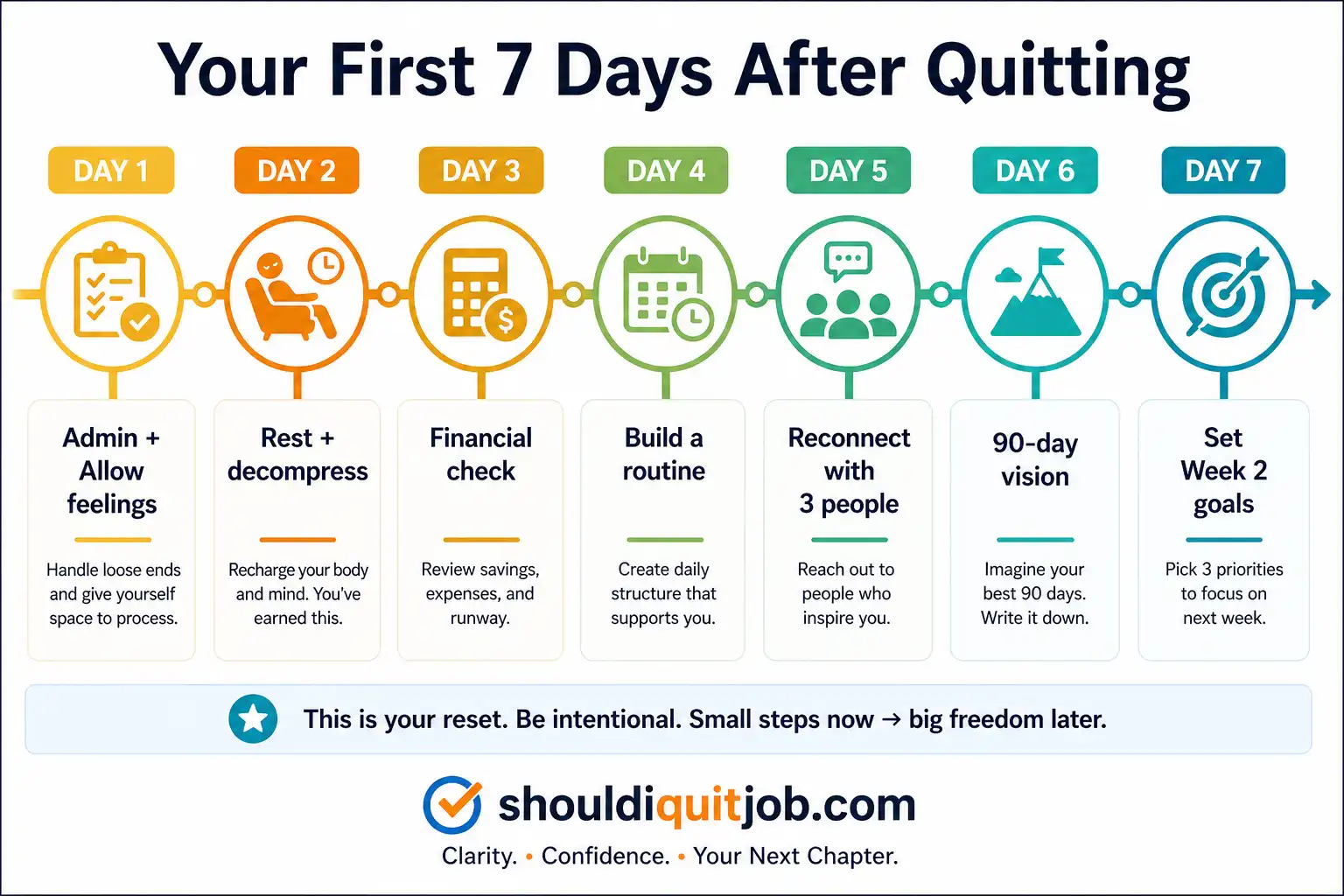
Day 1: Admin, Then Allow Yourself to Exhale
The first morning of not working is often simultaneously lighter and stranger than you expected.
Do the practical stuff first while you have the energy and the access.
Confirm your final paycheck. Know when it arrives, what it includes, and whether any unused leave is being paid out.
Return any equipment if it hasn’t been done already. Company laptop, phone, access cards. This seems obvious but a lot of people carry equipment for weeks after leaving.
Change any work-related passwords. Not to lock the company out - to close the loop on your own accounts. Any personal services you accessed through a work email or SSO.
Download what you’re entitled to. Your own performance reviews, references you received, work samples you have the right to keep. Do this before accounts are closed.
Then - and this part is important - allow yourself the rest of the day. You don’t need to plan your future this afternoon. The job took up space in your head for a long time. Spend Day 1 starting to reclaim it.
Day 2: Rest Without Guilt
Day 2 is for rest. Actual rest - not scrolling job boards while telling yourself you’re relaxing.
If there are people you want to catch up with, this is a good day for it. A friend for lunch, a walk, something that has nothing to do with work or what comes next.
Resist the urge to be productive. This isn’t laziness - it’s recovery. Most people who’ve been in a job that wasn’t right for them are more depleted than they’ve acknowledged. The rest is not a waste of time.
One exception: if your mental health has been significantly affected, contact a GP or therapist today rather than putting it off. The transition period needs support structures in place early.
Day 3: Financial Check-In
Day 3 is when you update your real picture.
Check the actual state of your finances. How much do you have? What are your monthly outgoings? At your current burn rate, how many months of runway do you have?
This is not a moment for anxiety - it’s a moment for clarity. Knowing exactly where you stand is better than the vague approximation most people carry around. If the number is smaller than you thought, you want to know that now while you have maximum time to respond. If it’s larger, that’s reassurance you don’t currently have.
Update your monthly budget if your expenses have changed without the job (commuting costs, lunches, work clothes). The number is often lower than people expect.
Day 4: Build a Routine
Day 4 is when the structure starts to matter.
The void that opens up without a working schedule expands to fill the time available - and not always in useful directions. People who look back on post-quit periods positively almost universally describe having built some structure early.
This doesn’t mean a punishing schedule. It means:
A consistent wake-up time. Not the same as your work alarm, but a real time, not a drift into whenever.
A clear start point for the day. After a morning routine - exercise, breakfast, whatever works for you - a point where the day’s activity begins.
An end point. When work is work and the evening is the evening. This boundary matters more once you’re not being given it externally.
The structure isn’t about productivity yet. It’s about having a shape to the day that makes it easier to operate inside.
Day 5: Reconnect with Three People
Not to ask for jobs. Just to connect.
Pick three professional contacts you want to maintain a relationship with - former colleagues, people in your field, someone from a previous role you’ve lost touch with. Send a short, genuine message. “I’ve just left [company] and I’d love to catch up when you have time” is complete and honest.
These aren’t job applications. They’re relationship maintenance - and the people who find good next steps quickly tend to have been maintaining these relationships before they urgently needed them. Day 5 is the start of that.
Day 6: The 90-Day Vision
By Day 6, the decompression is mostly done and some clarity is starting to arrive.
Spend an hour with a notebook and one question: what does success look like 90 days from now?
Not “what do I want from life” - that’s too big and too open. Just 90 days. What do you want to be true? A specific job accepted? A freelance client signed? A direction clearly decided? A business model tested?
The answer doesn’t have to be final. It just needs to be specific enough to work backward from. “I want to have clarity on what I’m doing next” is not a goal - it’s a feeling. “I want to have had five informational conversations in [field] and have a clear view on whether it’s the right direction” is a goal.
Write down the 90-day answer. Then identify three things that need to happen in Week 2 to start moving toward it.
Day 7: Set Up Week 2
The final day of the first week is about transitioning from recovery to momentum.
Define three specific goals for Week 2. Not a full plan - three things. Applications sent, conversations had, a document written, a skill started. Finite, completable goals.
Then decide when the active phase starts. If you’ve had a full week of rest and your mental health is stable, Week 2 is when the next thing begins. If you needed more recovery time, give yourself that - but set a specific date when the active phase starts, rather than letting it slide indefinitely.
The first seven days are the foundation. They don’t have to be perfect. They just have to end with you facing forward.
Ready for your answer?
Get a data-backed verdict in 2 minutes
13 questions. Personalised Leap / Wait / Stay verdict. Financial runway analysis. Basic report free · Full analysis available · No login required.
Analyse My SituationThis content is for informational purposes only and does not constitute professional financial, career, or psychological advice. If you're experiencing symptoms of depression, anxiety, or burnout, please speak with a qualified health professional.