Exactly What to Say When You Quit (Word-for-Word Scripts)
Scripts for every situation - standard resignation, toxic environment, no job lined up, health reasons, counter-offers, and the [exit interview](/blog/how-to-quit-without-burning-bridges).

Most people dread this conversation for weeks. They rehearse it at 2am. They imagine every possible response and how to handle each one.
And then the conversation happens, and it’s usually over in five minutes.
The reason it feels so loaded is that you’ve been holding the decision for a long time. The conversation itself is typically short, relatively straightforward, and nowhere near as confrontational as the anticipation suggests.
Here are the scripts. Use them as frameworks, not verbatim lines. They work because they’re clean, direct, and give the other person nothing to push back on.
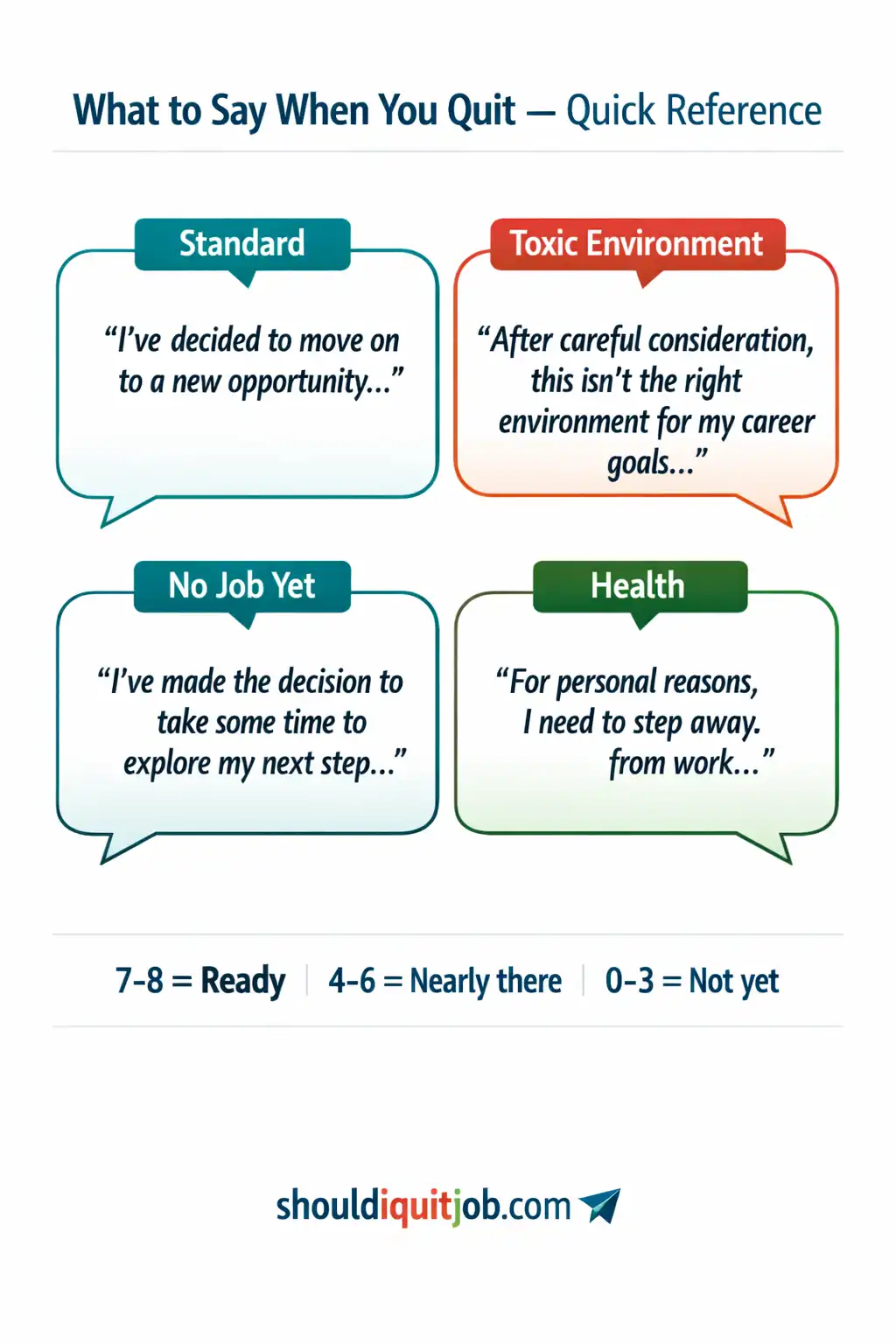
Script 1: Standard Resignation (Good Terms, New Role)
The conversation:
“I wanted to let you know that I’ve accepted a new role and I’m planning to resign. My last day would be [date based on your notice period]. I want to make sure we have a smooth handover and I’m happy to help plan that.”
Why it works. You’ve made a decision. You’re offering the transition support that a reasonable manager would want. There’s nothing to argue with.
What they’ll ask: “Can you tell me more about the role?” You don’t have to. “I’d rather keep those details private for now, but I’m genuinely looking forward to the next step.”
What NOT to say: Don’t explain everything about why you’re leaving. Don’t list grievances. Don’t reassure them excessively (“it’s not about you, it’s about me”) - that just opens a longer conversation.
Script 2: Leaving a Toxic Environment
The conversation:
“I’ve decided to move on. I’ve been thinking about this for a while and I feel it’s the right time. My last day would be [date]. I’d like to handle the transition professionally and hand over my work properly.”
Why it works. Clean. Non-specific. Nothing to escalate.
If they push for reasons: “I think I’ve reached a point where a change is the right next step. I’d rather not go into detail, but I appreciate you asking.”
What NOT to say: Don’t list the ways the environment has been harmful. Not now. Save that for the exit interview if you choose to share it, and frame it as observable patterns rather than character judgements.
The satisfaction of saying everything you’ve wanted to say is real but brief. The professional trail from a hostile exit is long.
Script 3: Quitting Without Another Job Lined Up
The conversation:
“I’ve made the decision to step back and take some time before my next role. This is something I’ve been planning, and I feel the conditions are in place to do it properly. My last day would be [date].”
If they ask what you’re doing next: “I’m taking a deliberate break to be thoughtful about the next step, rather than moving for the sake of moving.”
Why it works. It’s honest. It frames the choice as intentional, not reactive. Most reasonable people respect this, especially if you’ve prepared financially.
What NOT to say: “I have no idea what I’m doing next.” Even if that’s partly true, it doesn’t need to be in this conversation.
Script 4: Quitting to Start a Business
The conversation:
“I’ve decided to leave to pursue something I’ve been building on the side. My last day would be [date]. I’d like to help ensure a proper handover.”
That’s it. You don’t owe them the business plan.
If they’re curious: “I’d rather not get into the details while I’m still here, but I’m really looking forward to it.”
If there’s a non-compete clause in your contract: Look at it carefully before this conversation. If the business is in the same market, you may need to understand your obligations before you disclose anything.
Script 5: Leaving Due to Health or Mental Health
The conversation:
“I’ve made the decision to leave for personal reasons, including some health considerations. My last day would be [date].”
That’s genuinely it. You’re not obligated to specify further.
If they press: “I’d prefer to keep the details private, but I want you to know this is a considered decision.”
Why you shouldn’t over-explain: Once you’ve disclosed a specific health reason in a resignation conversation, that information is in the room. You can’t control where it goes. “Personal health reasons” is honest and complete.
Script 6: Leaving During Your Probation Period
The conversation:
“I’ve decided this role isn’t the right fit for me. I’d like to end my probation period. I’m happy to work whatever notice is appropriate.”
Probation exits are genuinely normal. Both sides can exit during probation. Don’t apologise excessively - it makes the conversation longer and less clear.
Script 7: Responding to “Can You Stay Longer?”
This comes up often. They need more time, the handover isn’t ready, they want to find your replacement first.
The response:
“I understand that’s difficult timing, and I want to help where I can. My last day is still [date] - but I’m happy to put together thorough documentation and brief whoever takes over before I go.”
You’ve given a clear no, an empathetic acknowledgement, and a practical alternative. That’s all that’s needed.
What NOT to do: Agree to extend indefinitely while they figure it out. Your notice period exists precisely to contain this.
Script 8: Responding to a Counter-Offer
You’ve handed in your notice. They’ve come back with more money, a new title, or both.
The response:
“I really appreciate this. I’ve thought about it carefully, and I’ve made the decision to move on. This isn’t primarily about [salary/title] - it’s about the direction I want to take. But thank you, genuinely.”
Why you should probably decline. The statistics on counter-offers are consistent: the majority of people who accept a counter-offer leave anyway within 12 months. The underlying reasons that made you want to leave don’t change. The money might, temporarily. But the relationship has also changed - your employer now knows you were about to leave.
The Exit Interview
This is optional. Most exit interviews are with HR, not your manager.
The purpose. For the company: to gather data on why people leave. For you: an opportunity to give honest feedback in a contained setting.
What to share. Specific, observable patterns. “I found that [process/dynamic/situation] was consistently [difficult/unclear/unfair]” is more useful than “this place is toxic.” Specific feedback is actionable. Venting isn’t.
What to hold back. Personal grievances about individuals. Anything that could come back as a legal or professional risk. Your honest opinion of every person who made your life difficult.
The final sentence of every exit interview. Leave it positive. Whatever you’ve shared, end with: “Despite these things, I’ve learned a lot here and I’m leaving with no bad feeling toward the individuals I’ve worked with.”
Whether that’s true or not, it’s how you want to be remembered.
Ready for your answer?
Get a data-backed verdict in 2 minutes
13 questions. Personalised Leap / Wait / Stay verdict. Financial runway analysis. Basic report free · Full analysis available · No login required.
Analyse My SituationThis content is for informational purposes only and does not constitute professional financial, career, or psychological advice. If you're experiencing symptoms of depression, anxiety, or burnout, please speak with a qualified health professional.