Should I Quit My Job to Start a Business? The 3-Month Revenue Test
The question isn't whether your business idea is good. It's whether it's consistent enough. Here's how to know when you're actually ready to go full-time.

The question isn’t whether your business is good.
Lots of good businesses fail because the founder went full-time too early - before the revenue was consistent, before the customer acquisition process was proven, before the financial runway was in place. They burned through savings trying to reach a threshold they could have reached while still employed, and ran out of room to manoeuvre.
The question is whether the business is consistent enough, and whether the conditions are in place to make the transition sustainable.
Here’s how to figure that out.
The 3-Month Revenue Test
Before you even think about quitting, your business needs to pass this test.
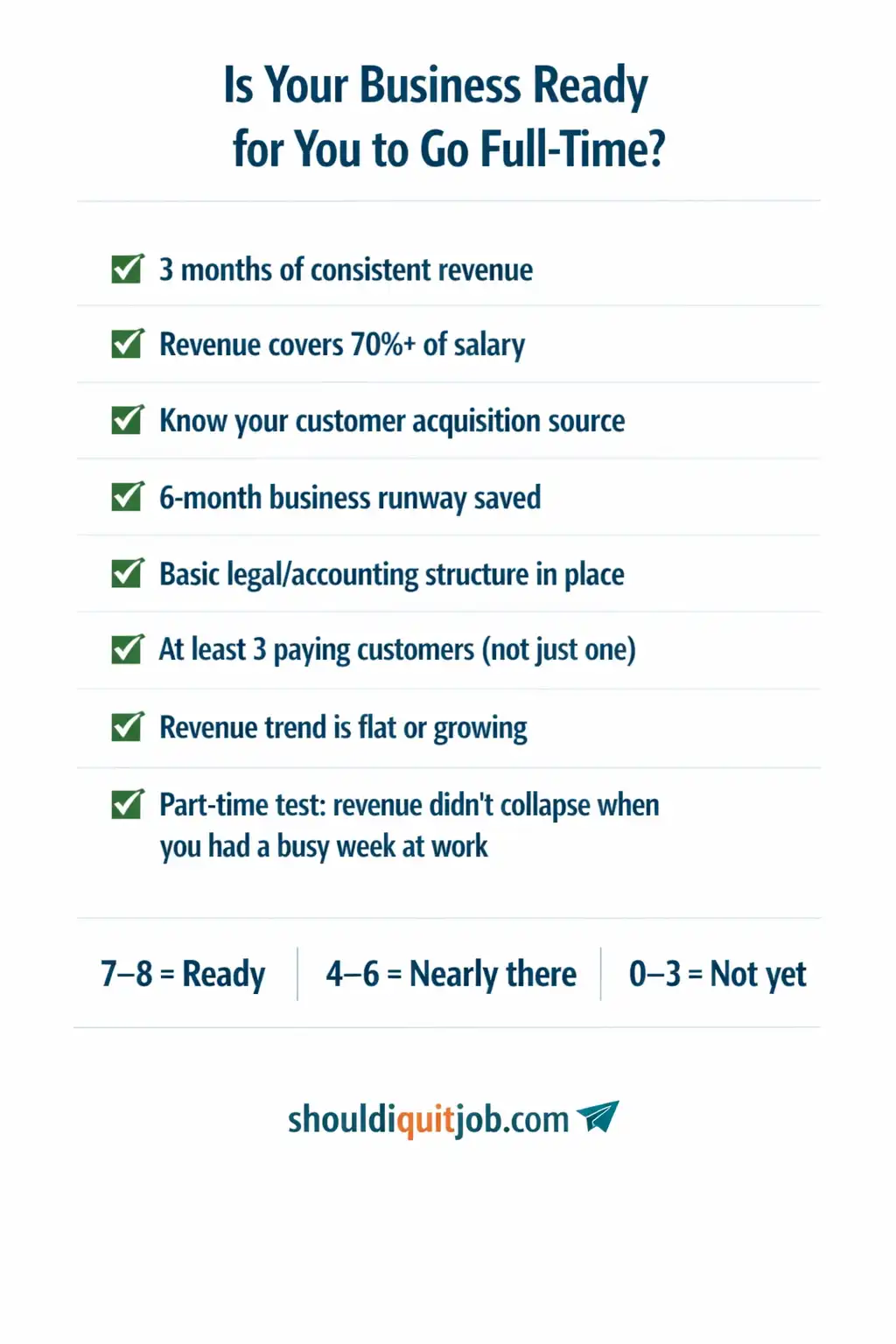
Has it generated revenue for three consecutive months? Not interest. Not “I have a few interested customers.” Actual money transferred, three months running.
Is that revenue growing, flat, or declining? Three months of growth is a different story from three months of the same number. Three months of decline is a warning sign.
Can you identify exactly where each customer came from? This is the most underrated question. If you don’t know how customers found you, you can’t predict where the next ones will come from. And without that, you can’t project whether going full-time would actually change your revenue trajectory.
What would realistically happen to revenue if you worked on it full-time? Be honest. Would removing the time constraint actually produce more customers? Or have you already found the natural ceiling for what the market wants right now?
Passing this test doesn’t mean quit immediately. It means the business has enough real signal to have a serious conversation about timing.
The Revenue Replacement Threshold
You need to replace more than just your salary.
When you’re employed, your employer covers costs you don’t see. Pension contributions. National Insurance (UK) or payroll taxes (US). Possibly health insurance, life cover, equipment. When you go self-employed, those costs land on you.
As a rough guide, you need your business to be generating 70 to 80 percent of your employed salary - gross, before tax - before quitting becomes financially sensible. That number needs to cover:
- Your equivalent salary
- Self-employed taxes (which are higher than employed taxes in most countries)
- Any benefits you were receiving that you’ll now pay for yourself
- Basic business operating costs
Below that threshold, you’re likely to be drawing down personal savings to supplement the business. Which shortens your runway and puts you in the position of making business decisions under financial pressure.
Beyond Revenue: What Else Needs to Be True
Consistent revenue is necessary but not sufficient. There are four other things worth having in place before you quit.
A six-month business runway, separate from your personal runway. Not your personal savings. A business account with enough to cover operating costs, software, tools, and slow months, for six months. Business and personal finances mixing during the early transition is one of the most common reasons the math stops working.
A customer acquisition process that doesn’t depend entirely on you being available all the time. If every customer came through a direct conversation you initiated, and you’ve been doing that in the gaps around a full-time job, going full-time might help. But it might also reveal that the channel doesn’t scale. Know how customers find you before you bet your income on it.
At least three paying customers, not one. One customer is a relationship. Three is a pattern. If 80 percent of your current revenue comes from one client, you don’t have a business yet - you have a freelance relationship. That’s not nothing, but it’s a different risk profile.
A basic business structure in place. A business account separate from your personal account. Basic accounting set up. An understanding of what you owe in tax and when. Contracts or agreements with clients if relevant. This stuff is boring, but the people who struggle most in year one are often the ones who deferred it.
Three Ways to Make the Transition
Cold turkey. Pick a date, resign, commit fully. The highest-risk approach - but also the one that produces the most focus. When the income must come from the business, it tends to.
Negotiated part-time. If your employer is open to it - and more are than people assume, especially if you have skills they need - dropping to three or four days a week while you build the business is the best of both worlds. Income continues, partial. Business gets meaningful time. The transition is gradual.
Sabbatical or leave of absence. Some employers, particularly larger ones, offer unpaid leave or career breaks. This gives you six to twelve months to test the business properly, with the option to return. Less common in smaller organisations, but worth asking.
The right approach depends on how ready your business is, your financial position, and your relationship with your current employer. Cold turkey makes sense when the business is genuinely ready and the job is the binding constraint. Part-time makes sense when the business is nearly ready and the employer is flexible.
A Worked Example
Maya has been working as a product manager and running a UX consultancy on the side for eight months. In the last three months, she’s generated £,800, ££100, and £3£00. Revenue is growing. She has four paying clients. She knows two came through LinkedIn content she posts, one through a referral, and one through a speaking slot at a meetup.
Her employed salary is £5,000 - roughly ££400 per month gross.
Revenue at 70% of salary: £,780 per month. She’s not quite there yet. But she’s close, and the trend is upward.
Her employer allows flexible working. She negotiates four days a week, taking a 20% pay cut to £2,000. Her effective monthly income drops, but it’s still stable. She has two days a week freed up to take on more client work and build more consistently.
Six months later, monthly revenue has reached £,200. She quits. She has a six-month business runway saved. She has a proven acquisition channel. She knows where clients come from.
That transition works because every step was built on evidence, not hope.
The Honest Question
If you had to bet your personal savings on whether your business would reach sustainability within 18 months of going full-time - would you bet?
If the answer is a confident yes: you probably know it’s time, or nearly time.
If the answer is a hopeful maybe: the business probably isn’t quite there. Build it further while still employed. The risk you’re deferring by waiting isn’t lost opportunity - it’s the runway you’ll need if things don’t go exactly to plan.
Ready for your answer?
Get a data-backed verdict in 2 minutes
13 questions. Personalised Leap / Wait / Stay verdict. Financial runway analysis. Basic report free · Full analysis available · No login required.
Analyse My SituationThis content is for informational purposes only and does not constitute professional financial, career, or psychological advice. If you're experiencing symptoms of depression, anxiety, or burnout, please speak with a qualified health professional.