Should I Quit My Job Without Another Job Lined Up?
Sometimes the healthy answer is yes. But only if you've done four things first. Here's the honest guide to quitting without a safety net.

Sometimes the right answer to “should I quit without another job lined up” is yes.
Not always. Not even usually. But sometimes staying in a job that’s harming you, waiting for the perfect next step to materialise before you leave, is a worse choice than leaving cleanly and figuring it out from the outside.
The question isn’t whether quitting without a job is inherently reckless. It’s whether the specific conditions are in place to make it survivable and productive.
When Quitting Without a Job IS Justified
Your health is at serious risk. When a job is producing ongoing physical or mental health consequences, the cost-benefit calculation shifts. Staying a few more months to find something isn’t free - it has a compounding cost. If continuing to stay means continuing to damage your health, that changes the equation.
The situation is toxic or abusive. Some environments make it nearly impossible to job search effectively while inside them. If you’re so depleted by the day-to-day that you can’t show up well to interviews, can’t write a coherent cover letter, can’t think clearly about what you want next - getting out first may be the only practical option.
You have enough runway. More on this in a moment, but if you’ve calculated your quit number and you’re there - you have the savings to support yourself through a job search without financial panic - then the risk is significantly lower than it is for someone leaving into nothing.
You have a concrete direction within a short window. “I’m going to spend the first month recovering, then actively job search” is a plan. “I’m leaving and I’ll figure it out” is not. You don’t need a job offer in hand - but you need enough of a next step to have some direction.
When It’s Not a Good Idea
Runway under three months. The most common reason a decision to quit without a job goes wrong. Job searches take longer than people expect. If you’re watching your savings approach zero while you’re still trying to find the right role, every interview happens under pressure. You take the first thing offered rather than the right thing.
Leaving purely out of anger or impulse. There’s a version of this decision that looks like strategy but is actually just escape. You had a terrible week - a bad review, a humiliating meeting, a final straw. The urgency feels overwhelming. But decisions made in that state often look different after 48 hours.
If the feeling is equally strong two days later after sleep and a bit of space, it’s probably real. If it’s softened significantly, the problem is real but the timing might not be right.
Complete absence of direction. No field in mind, no type of role you’re moving toward, no sense of what “better” even looks like. Quitting into total uncertainty can be more destabilising than most people expect, especially if there’s any depression or anxiety in the mix.
Two short tenures already on your CV. Not a hard rule - circumstances matter. But two exits under a year in a row raises questions in hiring. If the current situation is tolerable rather than actively harmful, it might be worth staying long enough to avoid the pattern.
The Pre-Quit Checklist
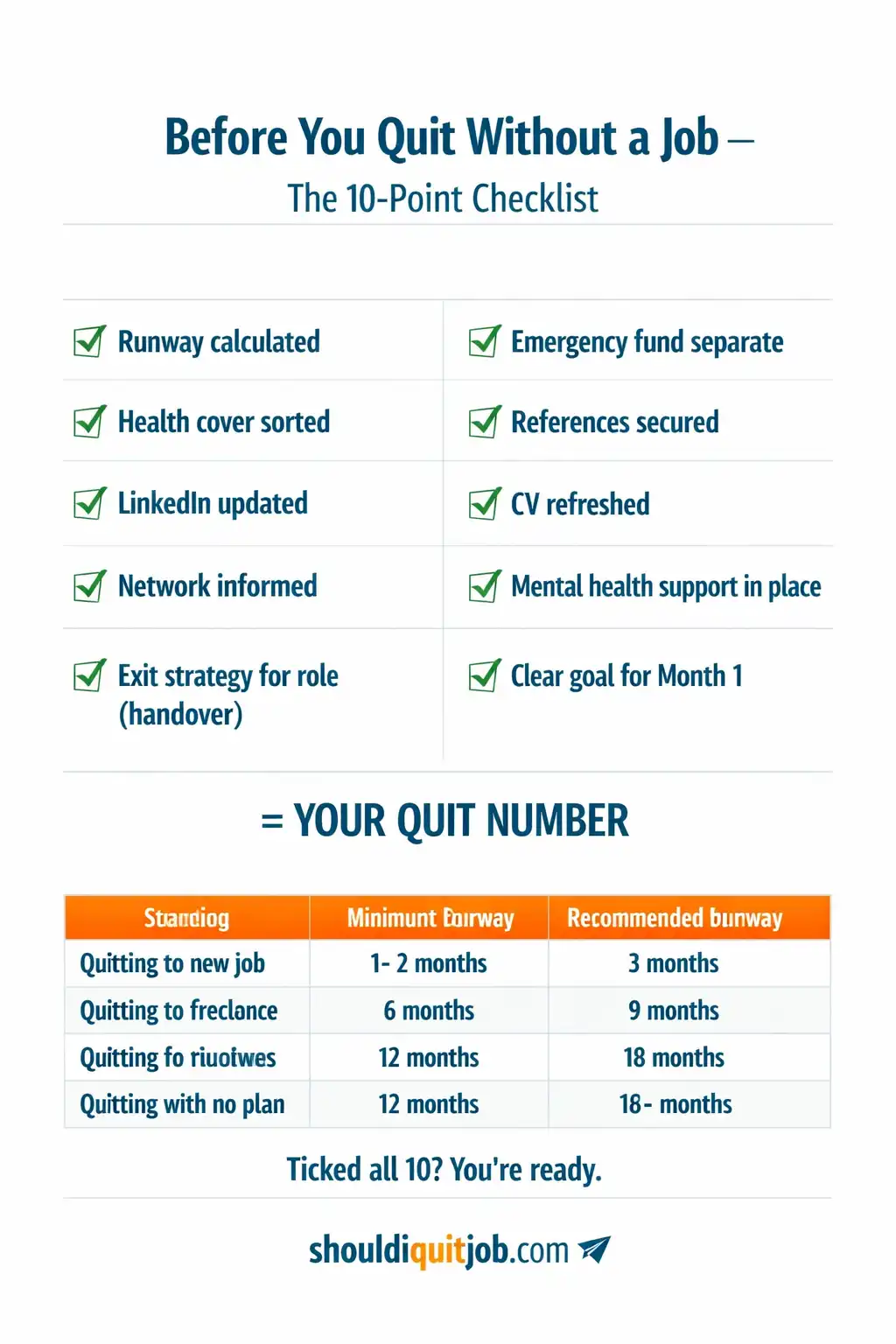
Before you hand in your notice, work through these ten things.
1. Calculate your runway. Monthly expenses times number of months you’d need, plus 20 percent. Know the number. Confirm you have it.
2. Build a separate emergency fund. On top of your runway, not part of it. Unexpected costs during a job search can force you into decisions you wouldn’t otherwise make.
3. Sort your health coverage. Understand what happens to your insurance the day you leave and have a plan for bridging it. In the US this is critical. Elsewhere, understand what employer-provided benefits you’re losing.
4. Line up your references. Do this while you’re still employed and on good terms. Don’t assume former managers will respond promptly to a cold call when you’re already mid-application.
5. Update your CV and LinkedIn before you leave. Not after. While you still have your title and your access to project details. Do it quietly, but do it before your last day.
6. Inform two or three trusted professional contacts. Not an announcement - quiet conversations. “I’m planning to move on in the next couple of months and would value a catch-up when you have time.” These conversations are much warmer when you’re not yet visibly desperate.
7. Document what you’re entitled to. Final paycheck, unused leave payout, equity vesting cliff, any notice pay. Know exactly what’s coming to you.
8. Have a mental health support structure. If mental health played any part in the decision, have a therapist or GP already in the loop before you leave. The transition period is harder than most people anticipate.
9. Know what Month 1 looks like. Not a full plan - just the first month. Some rest, some structure, a specific date when active job searching begins.
10. Decide on your exit narrative. Practice a clean, brief answer to “why did you leave?” that’s honest but not heavy. “I decided to take some time to make a deliberate move rather than a reactive one” is real and credible.
The First 60 Days: What to Expect
Days 1–14: Relief and disorientation in equal parts. The immediate relief of leaving is real. So is the identity wobble that follows. If your job was a big part of how you defined yourself, its absence leaves a strange gap. This is normal. Let it be strange for a bit.
Days 15–30: Build structure early. The biggest mistake in this period is letting the days become shapeless. A morning routine. Regular exercise. A daily start time, even if you’re working for yourself. Structure is protective when you’re in a transition.
Days 31–45: Begin active job searching. Not before this, for most people - the rest window matters. But by day 31, you should have a clear sense of what you’re looking for and be making active applications.
Days 46–60: Assess momentum. Are applications going out? Are you getting responses? Are first interviews happening? If not, something needs to adjust - whether that’s the targeting of applications, the CV, or the market you’re searching in.
Most people who do this well say the key is treating the job search as a job itself. Start time, end time, daily targets, weekly review. Not from day one - but once the recovery period is over.
One Last Thing
Quitting without a job lined up doesn’t have to be reckless. It can be the most strategic move you make - if the conditions are right and the preparation is done.
The people who regret it usually didn’t regret the decision to leave. They regretted leaving before the practical conditions were ready.
Get the conditions ready. Then go.
Ready for your answer?
Get a data-backed verdict in 2 minutes
13 questions. Personalised Leap / Wait / Stay verdict. Financial runway analysis. Basic report free · Full analysis available · No login required.
Analyse My SituationThis content is for informational purposes only and does not constitute professional financial, career, or psychological advice. If you're experiencing symptoms of depression, anxiety, or burnout, please speak with a qualified health professional.