Signs Your Job Is Actually the Problem (Not You)
Many people spend years trying to fix themselves for a job that was never right for them. Here's how to tell the difference between a personal failing and a bad environment.

There’s a particular kind of misery that comes from spending years in the wrong job.
It’s not just being unhappy at work. It’s the slow erosion of confidence. The creeping belief that you’re not as capable as you thought. The way you start to shrink - at work, and then gradually everywhere else.
What makes it worse is that good people tend to blame themselves. Not the job. Themselves.
They work harder. Try to adapt. Take the feedback. Assume the problem is some deficiency they need to overcome. And in the process they spend months or years fixing things about themselves that didn’t need fixing - for an environment that was never going to be right for them anyway.
Here’s how to tell if the job is the problem, not you.
10 Signs the Job Is the Problem
1. Your physical symptoms follow your work schedule
Headaches that appear on Monday and disappear by Saturday. Sleep that gets noticeably worse during work weeks and improves the moment you’re on leave. Tension in your neck or chest that you don’t notice on weekends.
Your body is not being dramatic. It’s responding to a genuine stressor and recovering when that stressor is removed. That pattern is information.
2. You perform well elsewhere but feel incompetent here
You handle complicated things in your personal life. You’re competent in every other area. But somehow, in this job, you feel like you’re constantly falling short.
That mismatch is a signal. Incompetence that only shows up in one specific environment usually isn’t about you.
3. The same work in a different context would feel fine
Think about the actual tasks you do - not the culture, not your manager, just the work. If you imagine doing that same work somewhere else, with different people, does the dread lift?
If yes, the job content is fine. The environment is the problem.
4. Multiple colleagues you respected have quietly left
When people who were good at their jobs and seemed settled start leaving without much fanfare, pay attention.
People who leave quietly - without a dramatic exit, without complaining on the way out - often do so because they spotted something systemic and decided not to fight it. They saw what you’re seeing.
5. You’ve tried to fix it and nothing changed
You had the conversation with your manager. You adjusted your approach. You asked for what you needed. You gave it time.
Same situation. Maybe slightly worse.
When nothing changes after genuine effort, it’s usually because the problem isn’t yours to fix. It’s structural or cultural, which means it’s not responding to your behaviour because your behaviour isn’t what’s causing it. If you’ve genuinely tried, read this before quitting - it separates a reactive exit from a strategic one.
6. Your manager takes credit or assigns blame unfairly
This one’s worth naming clearly because it’s more common than people admit. Your work gets presented upward without your name on it. When things go wrong, it lands on you. When things go right, it lands on your manager.
This is a management style, not a misunderstanding. If it’s happened more than twice, it’ll keep happening. It’s not something you can fix through better communication or a more positive attitude.
7. There’s no path forward no matter what you do
You’ve delivered good work. You’ve asked about progression. You keep being told “soon” or “not quite yet” or you’re given vague targets that shift when you reach them.
Sometimes this is budget. Sometimes it’s that the company just doesn’t promote from within. Either way, if you’ve been in the same position for two or more years and movement keeps not happening, that’s a pattern, not bad timing.
8. The job you were hired for isn’t the job you’re doing
The description said one thing. The reality is another. You were hired for a creative role and spend most of your time in admin. You were sold a senior position and got handed someone else’s problems.
A small gap between expectation and reality is normal. A large one - where what you actually do every day is fundamentally different from what you were promised - is a kind of ongoing dishonesty on the company’s part.
9. You feel worse about yourself after every performance review
Not constructively challenged. Worse. Like the goalposts shifted, or the feedback was about things you didn’t know were being assessed, or you left the room confused about what good even looks like here.
Good performance processes make people feel more capable and more directed. Bad ones make people feel inadequate and uncertain. If reviews consistently leave you feeling smaller, that’s not you being oversensitive.
10. Your inside-work self and your outside-work self are different people
The person you are at home - confident, warm, direct, funny, capable - and the person you become at work are recognisably different.
You’re more guarded at work. More hesitant. You second-guess yourself in ways you don’t elsewhere. The gap between those two people is being created by the environment. That’s not who you are - it’s how you’ve learned to survive where you are. Understanding why you feel stuck can help make sense of this pattern.
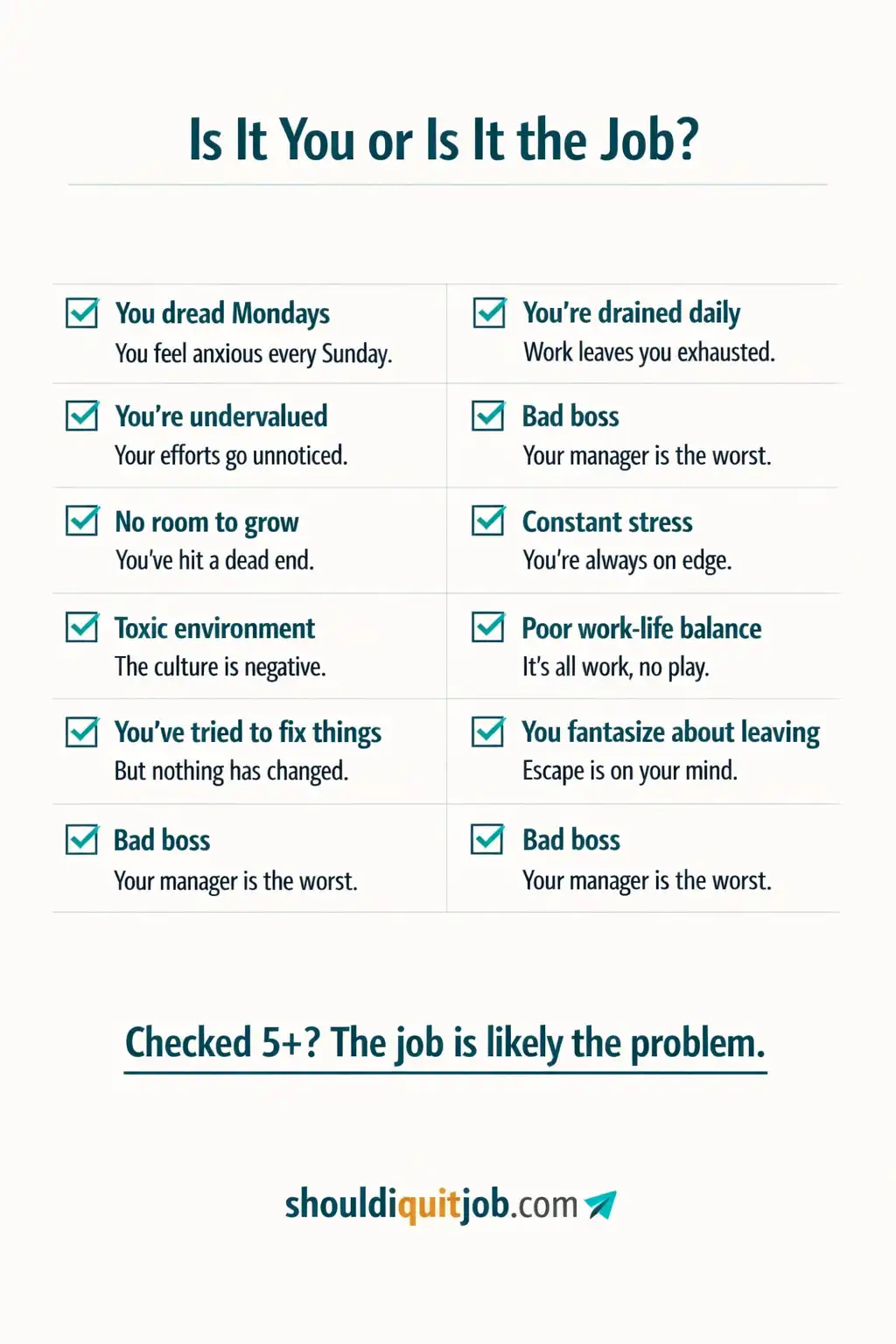
Why Good People Blame Themselves for Bad Jobs
If you recognise most of those signs, you probably already knew something was wrong. So why haven’t you trusted that knowledge?
Because the self-attribution trap runs deep.
Conscientious people assume that if something is going wrong at work, they must be the variable. They analyse their own behaviour. Look for what they could do differently. Take more feedback on board, even when the feedback is inconsistent or unkind.
It feels responsible to assume you’re part of the problem. But there’s a point where that kind of self-scrutiny stops being useful and starts being harmful - where you’re trying to fix yourself in response to a problem that isn’t about you at all.
The environments that are worst at producing this are often the ones most skilled at making it seem that way. When a company creates a culture of high expectations, constant feedback, and moving targets, people internalise the message that they just need to try harder. It keeps people in place. It keeps them quieter about what’s actually going on.
A Quick Exercise
Write down five times in the last month that work made you feel bad.
For each one, write down who or what caused it.
Then look at the list and ask: is the same name appearing more than once? Is the same dynamic repeating? Are these incidents distributed randomly, or do they cluster around specific people, specific processes, specific moments?
Patterns tell you where the problem lives.
If your list has your name on it most of the time - “I made a mistake,” “I didn’t handle that well” - take that seriously and look at whether there’s something genuine to work on.
If your list has other names on it, or describes the same structural situation over and over, stop trying to fix yourself. You’re not the variable here.
One More Thing
You don’t need to be certain before you act.
A lot of people get stuck waiting for irrefutable proof that it’s the job and not them. They want to rule out every possible way they could be at fault before they let themselves consider leaving.
That standard of proof doesn’t apply to the job’s behaviour. A place doesn’t have to be categorically terrible to not be right for you. A manager doesn’t have to be a villain to be consistently harmful to your confidence and wellbeing.
If the signs on this list are familiar, you’re probably not the problem.
That’s worth knowing. What you do with it is a separate question.
Ready for your answer?
Get a data-backed verdict in 2 minutes
13 questions. Personalised Leap / Wait / Stay verdict. Financial runway analysis. Basic report free · Full analysis available · No login required.
Analyse My SituationThis content is for informational purposes only and does not constitute professional financial, career, or psychological advice. If you're experiencing symptoms of depression, anxiety, or burnout, please speak with a qualified health professional.