Why You Feel Stuck in a Job You Hate (And What's Actually Keeping You There)
You know you should leave. You've known for months. Here's what's actually keeping you in place - and how to stop mistaking these forces for wisdom.

You know you should leave. You’ve known for months.
And yet here you are.
If this decision were simple, you’d have made it. The fact that you’re stuck means something is keeping you in place with more force than you’re giving it credit for. The question is whether that force is wisdom or inertia.
Most of the time, it’s inertia.
Here are the six psychological traps that keep people in jobs they hate - and why your brain keeps mistaking them for good judgment.
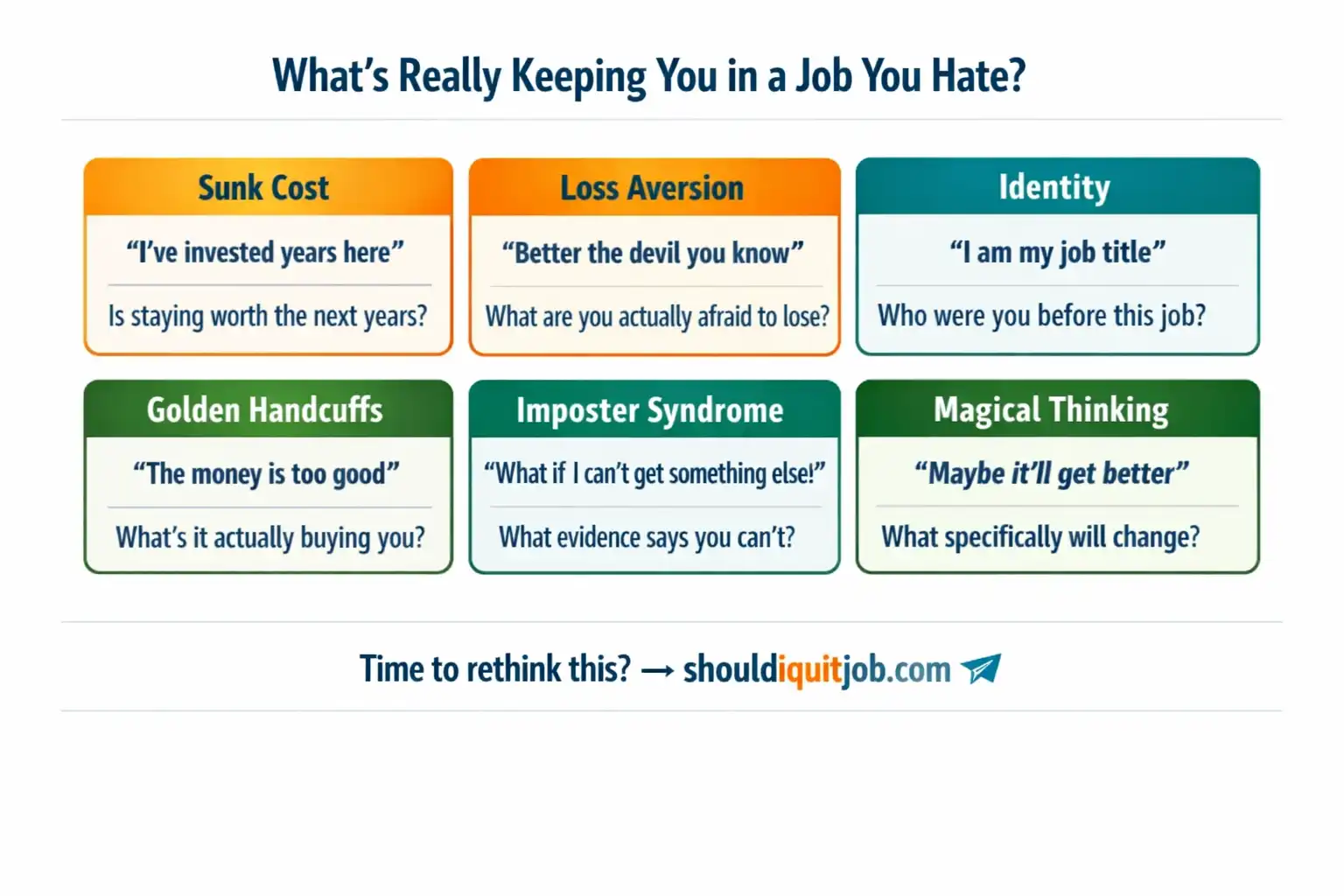
Trap 1: The Sunk Cost Fallacy
“I’ve invested four years in this company. Leaving now means wasting all of that.”
The years you’ve spent are gone whether you stay or go. The past investment is not recoverable - it’s already spent. The only question that’s actually on the table is what the next four years look like.
A rational decision-maker ignores sunk costs. They look forward, not backward. The question isn’t “was this worth what I put in?” It’s “is staying worth what it will cost going forward?”
Your brain doesn’t naturally do this. It treats past investment as an argument for continued investment, even when the underlying case for staying is weak. Behavioural economists call this the sunk cost fallacy - and it’s one of the most well-documented cognitive biases in existence.
The reframe: The years are already spent. They’re not coming back either way. The only question is what you do with what comes next.
Trap 2: Loss Aversion
“Better the devil you know.”
Kahneman and Tversky’s research on loss aversion showed that people feel the pain of losing something about twice as intensely as the pleasure of gaining something equivalent. Losing a stable salary feels about twice as bad as gaining a new opportunity feels good - even when the opportunity is objectively better.
This isn’t weakness. It’s just how brains work. The certain loss of your current income, your familiar routine, your known commute, is weighted enormously against the uncertain gain of whatever comes next.
What this produces: a status quo that feels much safer than it actually is. The current situation is known. The alternatives carry the psychological weight of uncertain loss, even when the expected value clearly favours change.
The reframe: The question isn’t “what do I risk by leaving?” It’s “what am I losing by staying?” When you frame inertia as a choice - because it is one - the loss aversion works both ways.
Trap 3: Identity Fusion
“I am a [job title] at [company]. Who am I without that?”
For many people, a job isn’t just a job. It’s a significant part of how they define and present themselves. “I’m a senior engineer at X” or “I work in investment banking” carries social weight, signals, and a sense of self that’s not easy to give up.
Quitting doesn’t just mean changing your work. It means changing your answer to “so what do you do?” It means the identity marker you’ve used for years is no longer available. That psychological loss is real and underrated in most career decision conversations.
The reframe: The identity was never really the company’s to give. It was always yours. What you do, how you think, what you’ve built - those things come with you. The job title was always just a label on something more durable.
Trap 4: Golden Handcuffs
“The money is too good to walk away from.”
High compensation is a real and legitimate consideration. This is the classic gilded cage problem. This one isn’t a pure psychological trap - there’s genuine financial reality embedded in it.
But it becomes a trap when people are using a number they haven’t actually examined. How much of your current salary do you actually need? What’s the gap between your current lifestyle and a sustainable one at a different income? Have you calculated what the pay cut would actually feel like - in monthly outgoings, not as an abstract percentage?
Many people discover, when they do the maths, that the gap between current compensation and what they’d accept elsewhere is smaller than it felt. They’ve been using a loose sense of “I earn well” as a reason not to look more closely.
The reframe: Money is a constraint, not an identity. Know the actual number you need. Then decide whether the premium above that is worth the cost you’re currently paying.
Trap 5: Imposter Syndrome
“What if I can’t get something else? What if I’m only employable because of this specific context?”
This fear is almost never as accurate as it feels, but it’s extremely common - especially in people who are competent enough to know what they don’t know.
The people most likely to worry they won’t find something else are usually the people who would find something else most easily. The skills, the judgment, the network, the track record - none of those disappear when you leave. They’re portable. What’s not portable is the specific context that’s been making you feel like you’re only barely adequate.
The reframe: Make a list of what you’ve actually built, learned, and delivered in the last three years. Read it back. Then ask whether someone with that track record would have difficulty finding their next role.
Trap 6: Magical Thinking
“Maybe it’ll get better on its own.”
You’ve been thinking this for a while. Three months. Six months. A year. And each time you’ve found something to point to - a new project coming, a management change upcoming, a restructure that might shake things up.
Sometimes things do change. More often, the core of what’s making you unhappy is structural and persistent, and the things you’re pointing to are ways to postpone the decision rather than genuine reasons to expect improvement.
The reframe: Name specifically what would have to change for staying to make sense. Now ask: how likely is each of those things actually to happen, and by when? If the honest answer is “probably not, or not soon” - the hope isn’t a strategy.
The Stuck Paradox
There’s a particularly cruel irony in the stuck state: the more miserable you are, the harder it is to take action - explore the fear of quitting.
Burnout depletes the executive function you need to plan an exit. Anxiety about the future narrows your focus to immediate survival. A battered sense of self-worth makes it harder to believe you’d be valuable elsewhere. The very thing that’s making the situation urgent is the thing that makes it hardest to address.
If this is where you are, the most important first move isn’t a resignation letter. It’s getting enough stability - rest, support, sometimes professional help - to be able to think clearly about what comes next.
You can’t make a clear-headed strategic decision from inside a crisis. Get stable first. Then decide.
One Exercise That Cuts Through Most of This
Imagine a close friend described their job to you exactly the way you’d describe yours. Same situation. Same feelings. Same stuck state.
What would you tell them?
You’re almost certainly better at advising them than advising yourself. The psychological traps described above apply to self-assessment far more than they apply to advising someone else.
Write the advice down. Then read it as if it were addressed to you.
Ready for your answer?
Get a data-backed verdict in 2 minutes
13 questions. Personalised Leap / Wait / Stay verdict. Financial runway analysis. Basic report free · Full analysis available · No login required.
Analyse My SituationThis content is for informational purposes only and does not constitute professional financial, career, or psychological advice. If you're experiencing symptoms of depression, anxiety, or burnout, please speak with a qualified health professional.