Burnout vs. Boredom vs. Bad Job - What's the Real Issue?
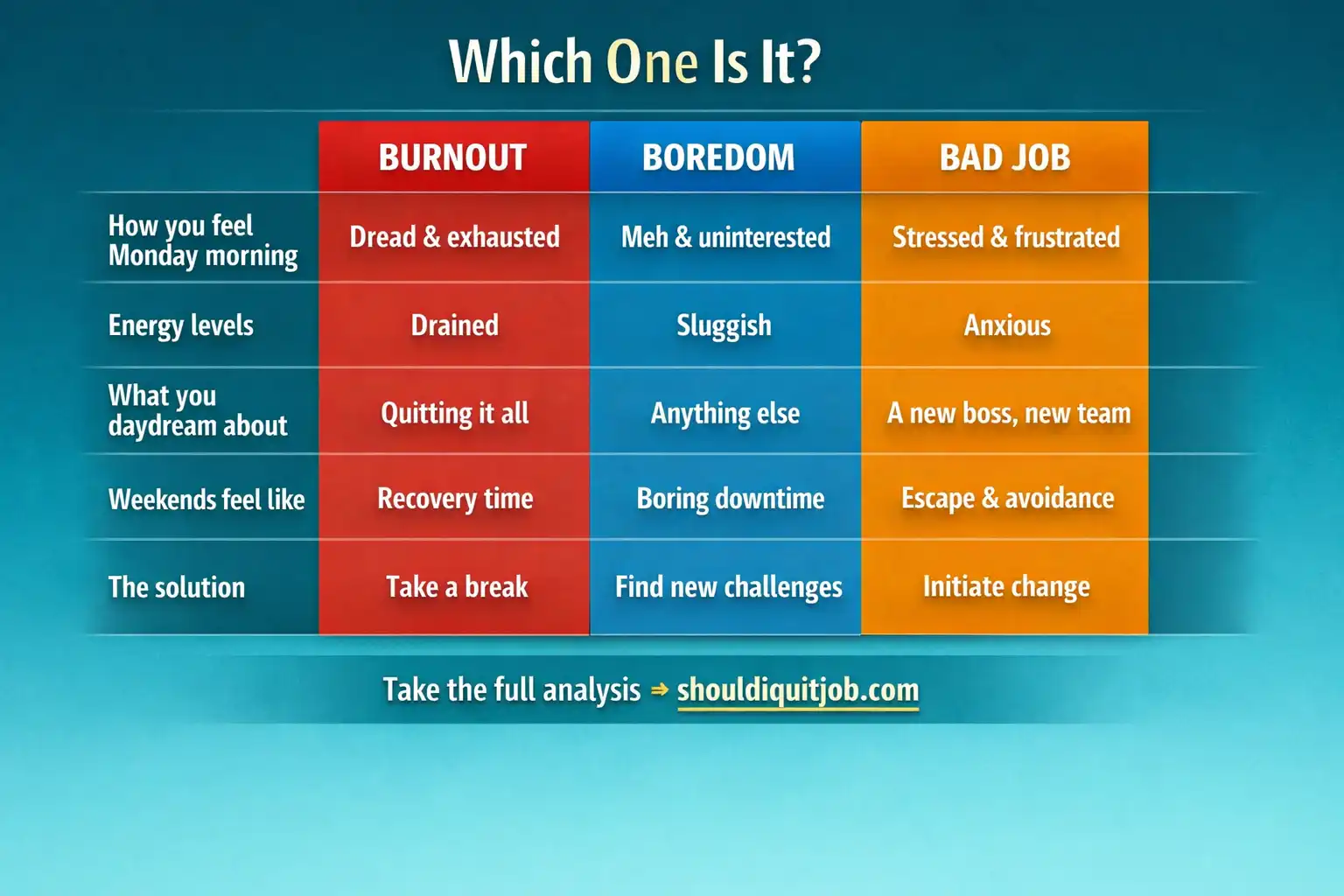
Three states that feel the same but have completely different solutions. Burnout needs rest. Boredom needs challenge. A bad job needs an exit.
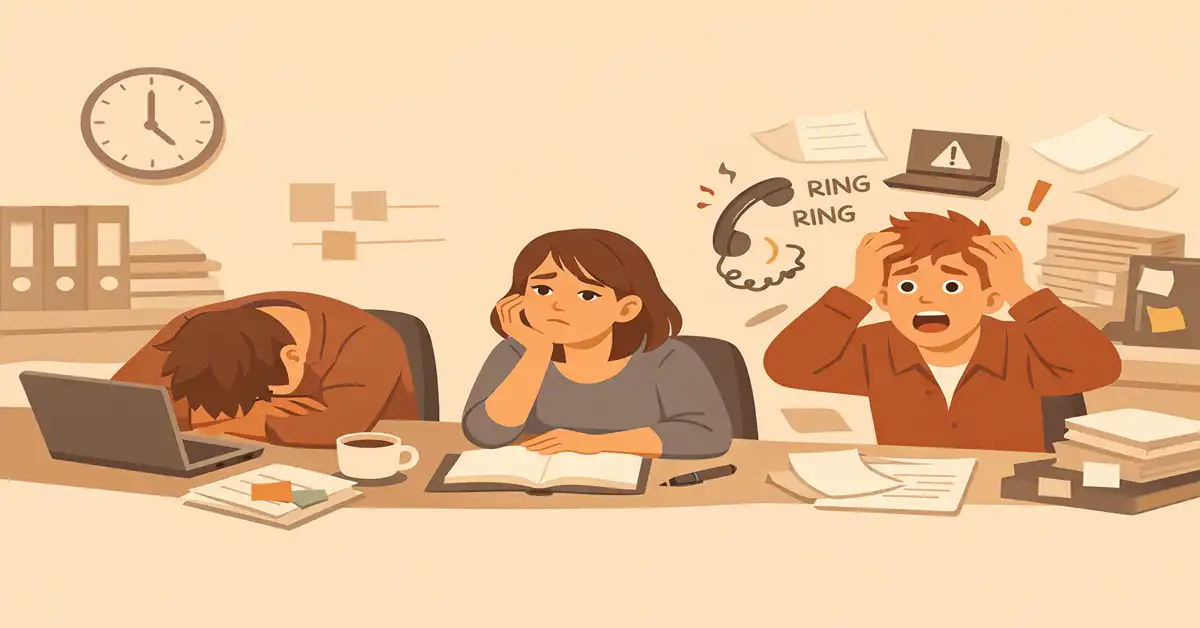
Here’s the mistake most people make.
They feel awful at work, decide they’re burned out, and treat the problem accordingly - take some time off, rest up, come back. Except they come back and everything is exactly the same. Because it wasn’t burnout. It was a bad job.
Or they feel flat and disengaged, assume the job has run its course, and quit. Except they take the same flatness to the next place, because the issue wasn’t the job - they were burned out, and they needed rest, not a new role.
Burnout, boredom, and a genuinely bad job feel similar from the inside. They all produce a version of “I don’t want to be here.” But they have completely different causes. And completely different solutions.
Getting the diagnosis wrong wastes months of your life.
Burnout
Burnout isn’t just being tired. Everyone gets tired. Burnout is what happens when exhaustion becomes structural - when you’ve been running on empty long enough that even rest stops working properly.
The clearest research framework for it comes from Christina Maslach, a psychologist who spent decades studying occupational burnout. Her model breaks it into three dimensions.
Emotional exhaustion. You have nothing left to give. The energy required to do your job - to care, to engage, to think - feels like more than you have. You’re depleted before the day starts.
Cynicism. You’ve started to detach. You used to care about the work, your colleagues, the outcomes. Now it all feels distant. You’re going through the motions. The cynicism isn’t a personality trait - it’s a defence mechanism. When you’re exhausted enough, not caring becomes a way of protecting yourself.
Reduced efficacy. You feel incompetent in a way you didn’t before. Tasks that used to feel manageable now feel enormous. You doubt your own ability. You wonder if you were ever actually good at this.
If all three of those are happening, that’s textbook burnout.
What drives it. Too much for too long. An extended period of high demand, low control, or both. Not enough recovery time. A job that constantly takes more than it gives back.
The key signal. Burnout doesn’t discriminate by job type. You can burn out in a job you love. People burn out doing work they care deeply about - teachers, doctors, designers, founders. If you’ve hit burnout, it’s not necessarily that the work is wrong for you. It’s that the conditions have been unsustainable.
The Sunday test. With burnout, Sunday evenings feel heavy. You dread going back not because of anything specific - no bad meeting coming, no difficult person to face - just a generalised heaviness. A sense of depletion rather than specific dread.
Boredom
Boredom doesn’t get taken seriously enough as a career problem. But chronic understimulation is genuinely uncomfortable. And the longer it goes on, the more it looks like something worse.
Boredom at work means you’re performing below capacity. The problems aren’t interesting enough. The pace is too slow. You’re not being stretched. You know you could do more, but the opportunity isn’t there.
What it feels like. Not drained - flat. You’re not exhausted at the end of the day, you’re just… not engaged. The Sunday scaries are mild. You’re not dreading work. You’re just indifferent to it, which after a while starts to feel like its own kind of misery.
The key signal. Boredom tends to respond to change. Get assigned to a new project, work with a new team, take on something you haven’t done before - and suddenly the flatness lifts. That responsiveness tells you the problem is stimulation, not the job itself.
What drives it. Usually one of three things. You’ve outgrown the role and aren’t being given enough to take on. The job was always a poor fit for your capabilities. Or you’ve been so busy managing the grind that you stopped investing in growth, and now you’ve plateaued.
The honest self-check. Ask yourself: when did you last feel genuinely interested in something at work? If you can point to a specific period - a project, a team, a phase - and it ended, that tells you something. The capacity for engagement is still there. The conditions for it aren’t.
A Bad Job
A bad job is different from both of the above. With burnout, the issue is your resource levels. With boredom, the issue is stimulation. With a bad job, the issue is the environment itself.
The work is fine. You’re not depleted. You’re not bored. But the place is genuinely wrong - toxic culture, leadership that behaves badly, values that clash with yours, a team that’s politically hostile or simply unkind.
What it feels like. A specific, directional dread. Not generalised heaviness like burnout - you dread particular things. Monday morning meetings. Interacting with a specific person. The performance review process. The all-hands where the CEO says things you don’t believe.
The key signal. Bad job dread is usually specific and consistent. The same things bother you in the same ways. It doesn’t fluctuate much with your energy levels - even when you’re well-rested, being there feels wrong.
What drives it. A mismatch between you and the organisation. Sometimes it’s one person (a bad manager can make an entire job feel toxic). Sometimes it’s structural - the culture rewards behaviours you don’t respect, or punishes ones you do. Sometimes it’s a values misalignment that started small and became impossible to ignore.
Quick Diagnostic: Which One Is It?
Go through these questions. Keep track of how many yes answers land in each column.
| Question | Burnout | Boredom | Bad Job |
|---|---|---|---|
| Do you feel exhausted before the day starts? | ✓ | ||
| Are you detached in a way you didn’t used to be? | ✓ | ||
| Do tasks that used to feel easy now feel enormous? | ✓ | ||
| Is the Sunday dread vague and heavy, not about anything specific? | ✓ | ||
| Do you feel flat rather than exhausted? | ✓ | ||
| Would a new project or challenge probably help? | ✓ | ||
| Do you think you’re performing below your actual capability? | ✓ | ||
| Is the dread tied to specific people or situations? | ✓ | ||
| Does the place conflict with your values? | ✓ | ||
| Have the same issues persisted regardless of how well-rested you are? | ✓ |
The column with the most yes answers is probably where your problem lives.
Solutions by Category
If it’s burnout
Rest is not optional - it’s the treatment. Not a weekend. Actual extended recovery time if you can get it. Medical leave is more accessible than people think, and in many countries a GP will sign off on stress-related leave more readily than you’d expect.
Shorter term: stop doing any non-essential work outside your contracted hours. Draw a hard line. Burnout is not a character flaw - it’s a supply and demand problem, and you’ve been running a deficit for too long.
The big question to sit with: were the conditions that caused this temporary, or are they structural? If temporary, recovery might be enough. If structural, you’re recovering to walk back into the same situation, which just restarts the clock.
If it’s boredom
Have the conversation. Tell your manager you want more. Be specific about what - a particular type of project, a different responsibility, something you haven’t had the chance to do yet.
If that conversation goes nowhere, look internally. A different team, a different project. Boredom is often fixable without leaving. It requires a bit of advocacy and sometimes a bit of patience while the right thing becomes available.
If you’ve genuinely outgrown the role and there’s no upward path, that’s useful information. It’s not a crisis - it’s just time for the next step.
If it’s a bad job
The target is exit. Not immediately, not impulsively, but intentionally.
If the problem is one specific person - a manager - it might be solvable through an internal move. But if it’s cultural, structural, or values-based, no internal move is going to change the fundamental experience. You’re in the wrong place. The plan is to leave it, on your timeline, from a position of preparation rather than desperation.
Start the job search while you’re still employed. Build financial runway in parallel. Give yourself a clear exit date rather than an indefinite vague plan to leave “eventually.”
When It’s a Mix of All Three
The worst situation is when all three are present at once.
You’re burned out from a demanding, toxic environment. You’ve been there so long the work has become stale. And the culture is genuinely bad.
When that’s the case, prioritise in this order.
Health first. If you’re at the point of physical or mental health symptoms, that takes precedence over the financial or career calculus. Get stability - whether that’s leave, reduced hours, or simply getting out.
Then finances. Before you can do anything else, you need to know what your runway looks like. Can you afford to leave? If not yet, how long before you can?
Then direction. Once health is stable and finances are clear, you can figure out what comes next. This order matters. Trying to figure out your next career move while you’re deeply depleted, in financial panic, or both, produces bad decisions.
The reason this distinction matters is that the solutions are non-transferable. Rest doesn’t fix a bad job. Quitting doesn’t fix burnout. And a new project doesn’t fix a toxic culture.
Figure out which problem you actually have. Then solve that specific problem, not the adjacent one.
Ready for your answer?
Get a data-backed verdict in 2 minutes
13 questions. Personalised Leap / Wait / Stay verdict. Financial runway analysis. Basic report free · Full analysis available · No login required.
Analyse My SituationThis content is for informational purposes only and does not constitute professional financial, career, or psychological advice. If you're experiencing symptoms of depression, anxiety, or burnout, please speak with a qualified health professional.