My Job Is Making Me Depressed: When to Quit, When to See a Doctor, and What to Do First
If work is affecting your mental health in serious ways, the decision isn't just about your career. Here's how to think through it carefully and safely.

If you’re in crisis right now, please reach out to a mental health helpline in your country before reading further. In the UK: Samaritans at 116 123. In the US: 988 Suicide and Crisis Lifeline. In India: iCall at 9152987821.
This isn’t a normal “should I quit my job” question.
When your mental health is involved - really involved, not just “work is stressful” - the stakes are higher. The decision is more complicated. And the instinct to just leave and figure it out later, while understandable, can sometimes make things harder rather than better.
Let’s slow this down.
Is It the Job, or Is It Clinical Depression?
This distinction matters enormously - not to minimise what you’re going through, but because it changes what you should do first.
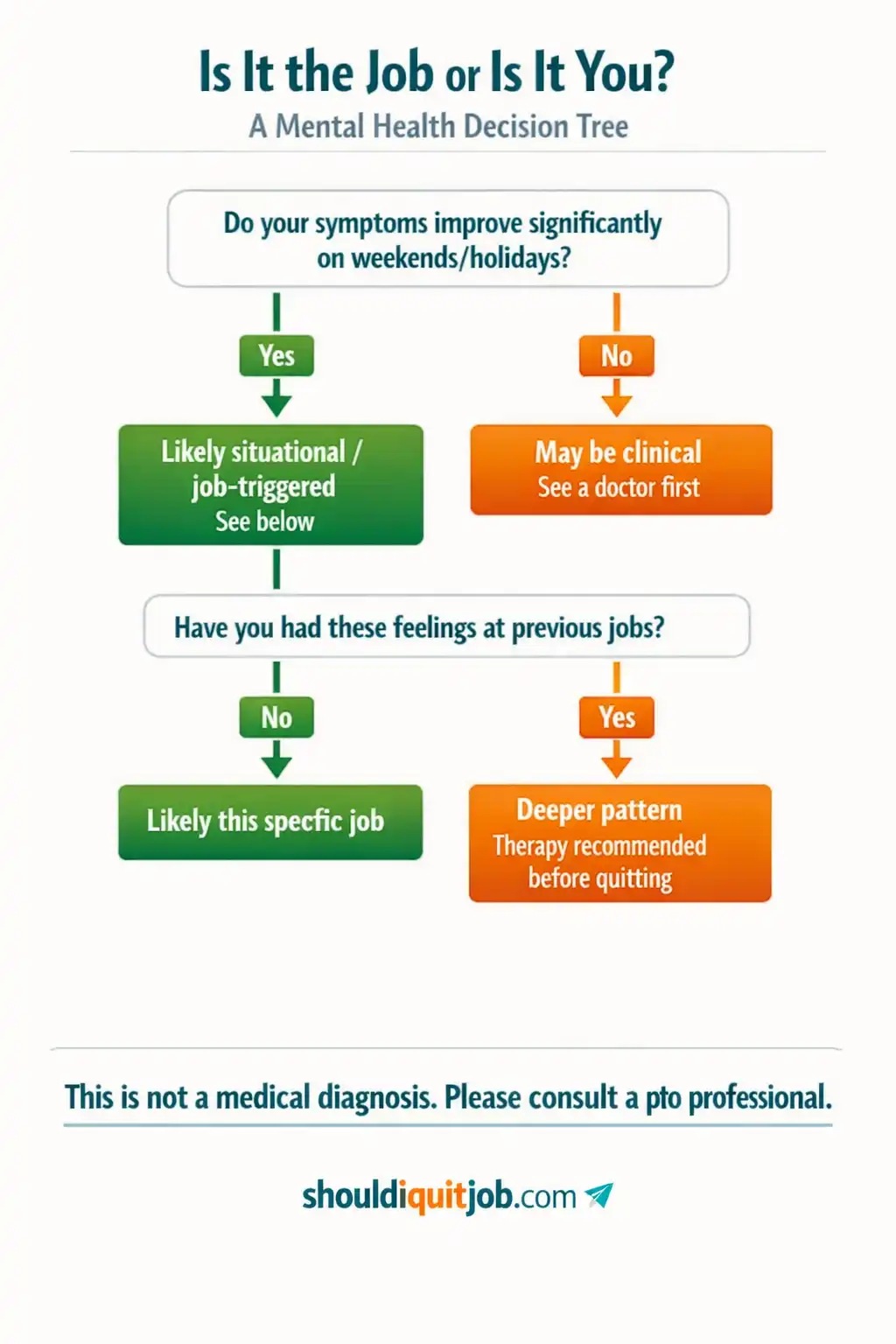
Situational depression - sometimes called adjustment disorder - is triggered by external circumstances. A toxic job, a hostile manager, relentless overwork, a work environment that’s been grinding you down for months. In situational depression, your symptoms are closely tied to the source. They lift when the source is removed.
The clearest signal: do things improve significantly when you’re away from work? On a proper holiday, a period of sick leave, a long weekend where you genuinely disconnected - do you feel meaningfully better? If the answer is yes, the job is likely the primary driver.
Clinical depression is different. It doesn’t require an external trigger, and it doesn’t reliably lift when the trigger is removed. It affects sleep, appetite, concentration, and sense of self in ways that persist regardless of context. You can be on a beach in the sun and still feel completely empty.
If your low mood, exhaustion, or hopelessness is constant and doesn’t ease when you’re away from work, please see a doctor before you make any career decisions. Not because quitting is wrong - but because quitting into clinical depression without support in place rarely produces the relief you’re hoping for.
Both of these are real. Both deserve care. The difference is in what you need first.
What to Do Before Deciding Whether to Quit
The instinct when you’re in pain is to remove the source as quickly as possible. That instinct makes sense. But a sudden, unplanned exit when you’re not well can narrow your options significantly.
Here’s what to do first.
See a GP or mental health professional. This is the first step regardless of what you decide about work. Get a proper assessment. Understand what you’re dealing with. A GP can also sign you off for medical leave - more on that in a moment.
Know your rights. In most countries you have more workplace rights around mental health than you probably realise. In the UK, depression qualifies as a disability under the Equality Act if it has a substantial, long-term effect on your daily life - which means your employer is legally required to make reasonable adjustments. In the US, FMLA provides up to 12 weeks of job-protected unpaid leave for serious health conditions. Know what applies to you before you hand in your notice.
Consider medical leave. Sick leave isn’t just for broken bones. If your mental health is significantly affected by work, a GP can and often will sign you off. This buys you time - to rest, to think clearly, to see a therapist, to start a quiet job search from a position of stability rather than desperation. The income continues. The options stay open.
Don’t make permanent decisions while you’re at your worst. The way you see your situation when you’re depleted is not the same as how you’ll see it with rest and support. This doesn’t mean delay indefinitely. It means give yourself two weeks of genuine rest before you make anything final.
Signs the Job Is the Primary Driver
Some situations are clear enough that staying longer isn’t a neutral choice. These are signs that the job is the main source and that some form of exit - planned carefully - is probably the right call.
Your symptoms follow your schedule. Feel bad Monday through Thursday, a bit better Friday, genuinely different on weekends and holidays. Your nervous system is relaxing when the stressor is removed. That’s information.
Multiple people on your team have reported similar feelings. When several people independently describe the same experience of working somewhere, the issue is the environment - not each individual’s resilience.
The environment is objectively toxic. Chronic overwork is normalised. Psychological safety doesn’t exist. Cruelty, humiliation, or sustained pressure that would be recognised as harmful by anyone watching from the outside.
You’ve improved during previous leaves and deteriorated on return. If you’ve had sick leave or holiday and felt genuinely better - only to feel the same or worse within weeks of going back - staying is an active choice to damage your health.
The Quit Decision When Mental Health Is Involved
Quitting can absolutely be the right answer. But it needs more preparation than a standard job exit, not less.
Financial safety net matters more than usual. The financial stress of leaving without enough runway can worsen depression and anxiety, not relieve it. Before you go, know your number. Monthly expenses multiplied by how many months you’d need, plus a buffer. If you’re not there yet, a period of medical leave while you build toward it may be worth considering.
Have support in place before you leave. A therapist, a GP who knows your situation, people in your personal life who understand what you’ve been through. The transition period after quitting is often harder than people expect - even when quitting was clearly right. Having professional support already in place makes a real difference.
Quitting into nothing can make depression worse. Structure, purpose, and social connection all reduce depressive symptoms. If you quit without any framework for what the next few weeks look like, you may find the relief of leaving is followed quickly by the disorientation of unstructured time. It doesn’t have to be a full plan - but “what does Monday look like” is worth thinking about.
A rough next step is better than no next step. You don’t need a perfect plan. You need enough of one to have some direction. Even “I’m going to spend two weeks resting, then start a quiet job search” is better than an open-ended void.
A Note on Going Back
If you’re staying in the same field and leave due to mental health, you can return. People do it regularly. A gap explained as a health matter - without specifics - is understood in most professional contexts. “I took time off for health reasons” is a complete sentence that most interviewers will accept without pressing.
The concern about career damage is real but usually overstated. A few months’ gap is survivable. The cost of staying in a role that’s making you genuinely unwell is not.
What Comes First
If you’re in a bad enough place that you’re Googling this, the priority is your health. Not your notice period, not what it looks like on your CV, not whether you have another job lined up.
Get support. Talk to a doctor. Know your options. And then make a decision - ideally from a slightly steadier place than right now.
The career stuff is solvable. It’s worth protecting the foundation it sits on.
Ready for your answer?
Get a data-backed verdict in 2 minutes
13 questions. Personalised Leap / Wait / Stay verdict. Financial runway analysis. Basic report free · Full analysis available · No login required.
Analyse My SituationThis content is for informational purposes only and does not constitute professional financial, career, or psychological advice. If you're experiencing symptoms of depression, anxiety, or burnout, please speak with a qualified health professional.