Should I Quit My Job? The Complete 2026 Guide
A data-driven guide to the hardest career decision you'll make. Covers the 3-path model, the 5 factors that actually matter, red flags, green flags, and a decision framework you can use today.
 decision framework for career changes](/images/blog/should-i-quit-my-job-complete-guide.webp)
It’s Sunday evening. Dinner’s done. You’ve been trying to relax since noon.
You haven’t managed it.
There’s this low hum of dread sitting in your chest, and the closer Monday gets, the louder it gets. You check Slack. Not because anything new is there. You already read it Friday. You’re just bracing.
You close the laptop. Think about quitting. Think about what that costs. Open the laptop again.
If this is you, you’re not dramatic. You’re not weak. You’re stuck in a loop that millions of people are stuck in right now, trying to make a genuinely hard decision without a clear way to think through it.
Here’s how to think through it.
Why This Decision Feels So Hard
You already know something needs to change. So why haven’t you decided yet?
Three reasons. And none of them are your fault.
You’re anchoring to what you’ve already put in. Three years. Four. Maybe more. Leaving feels like throwing all of that away. But here’s the thing: those years are gone whether you stay or go. The only question is what the next three years look like.
Your brain treats potential loss as twice as painful as gain. Losing a stable salary, a familiar routine, a known commute, these things feel catastrophic. Even when what’s waiting on the other side is objectively better. This isn’t irrationality. It’s just how brains work.
Your identity is tied to your job. “I’m a senior engineer at X.” “I’m a teacher.” Quitting doesn’t just mean changing jobs. It feels like changing who you are. That’s a bigger psychological weight than most people acknowledge.
Once you see these three forces at work, you can stop mistaking them for wisdom. They’re not telling you to stay. They’re just making noise.
There Are Three Options, Not Two
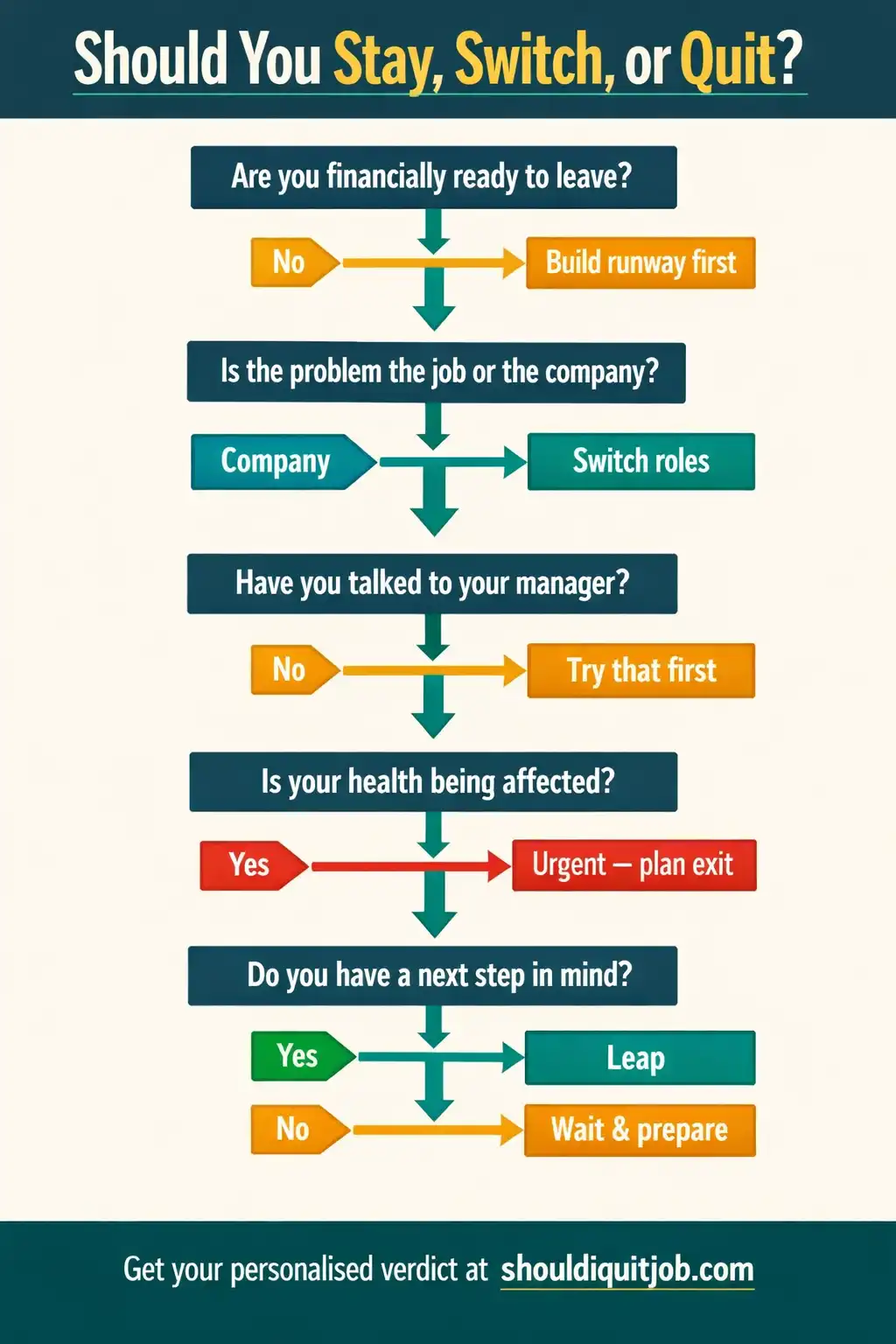
Most people frame this as binary: stay or quit. That framing makes everything harder. The 3-path model explains all three options clearly.
There’s actually a third option, and it’s the one most people skip.
Option 1: Stay, but fix something specific
This isn’t “stick it out and hope things improve.” A real Stay means identifying exactly what’s broken, making a plan to fix it, and giving yourself a deadline to reassess.
It works when the problem is fixable. A bad manager who’s probably leaving. A project that’s finally wrapping up. A salary gap you haven’t actually tried to negotiate.
Priya was ready to quit her UX role at a fintech company. She’d been miserable for months. But when she sat down and thought about it, she realized 90 percent of her unhappiness came from one person: her micromanaging, credit-stealing manager. She asked for an internal transfer. It was awkward. It worked. Six months later, same company, different team, totally different experience.
The company wasn’t the problem.
Option 2: Switch to a different employer
This is the most underused option. If the work itself is fine but the company is the problem, switching employers often solves it without the financial risk of quitting.
You keep your income. You leave from a position of strength. And a move to a better company looks like normal career progression on paper.
James was a software engineer who’d spent eight years at a consulting firm. He wasn’t burned out on coding. He was burned out on consulting: always billable, never owning anything, constantly managing client politics. He moved to a product company. Took a modest pay cut. Within three months, he described it as the first job he’d actually looked forward to in years.
He didn’t need to quit the industry. He needed to leave that specific environment.
Option 3: Quit
Sometimes the work itself is wrong. Or your health is at risk and staying isn’t a neutral choice. Or you have the runway to take a deliberate break and figure out what’s next.
This path has the most risk. It also has the most potential upside. The people who regret it usually didn’t regret the decision to leave. They regretted leaving before the conditions were right.
More on those conditions in a moment.
Five Things That Actually Tell You Whether to Quit
Not feelings. Not a bad week. Not someone else’s opinion. These five things.
1. Your finances
This is the most important variable and the one people assess most optimistically.
You need to know your quit number before you decide anything. Your quit number is your monthly expenses multiplied by how many months of runway you need, plus a 20 percent buffer on top.
Here’s how much runway you actually need:
| Situation | Minimum | Recommended |
|---|---|---|
| Quitting into a new job | 1 month | 3 months |
| Quitting to freelance | 6 months | 9 months |
| Quitting to start a business | 12 months | 18 months |
| Quitting with no plan | 12 months | 18+ months |
Most people also forget to account for losing employer benefits. Health insurance, pension contributions, travel allowances. That’s often another 15 to 25 percent on top of your monthly costs.
Calculate the number. Then everything else gets clearer.
2. What’s happening to your health
There’s a difference between “work is stressful” and “this job is making me ill.”
The line is roughly this: are your symptoms tied to your work schedule? If anxiety, insomnia, and low mood get significantly worse during work weeks and improve noticeably on holidays, the job is likely the trigger.
Staying in a role that’s genuinely harming your health is never neutral. The cost compounds.
3. Whether this role is building anything
Is this job developing skills that matter? Growing your network? Setting you up better for your next move?
If the answer is no, staying isn’t just uncomfortable. It’s costing you compound career growth. Every year in the wrong role is a year you didn’t spend building toward the right one.
4. Your relationship with your manager
Research consistently shows your direct manager is the single biggest predictor of your daily experience at work. A good manager at a mediocre company beats a bad manager at a prestigious one almost every time.
Be specific: is this one difficult person who might leave or change, or is the problem structural and everywhere?
The answer changes which option is right.
5. Whether this job moves you toward anything
Where do you want to be in three years? Does staying at this job move you closer or further from that?
You don’t need a grand vision. You just need an honest answer. A job that doesn’t move you toward your goals isn’t neutral. It’s an active cost.
Signs It’s Time to Go
These patterns consistently point toward leaving being the right call.
Your symptoms follow your schedule. Headaches Monday that disappear Friday. Sleep that improves the moment you’re on leave. Your body is not being dramatic.
You’ve tried to fix it. Nothing changed. You had the conversation. Made the request. Asked for the transfer. Six months later, same situation. Some problems aren’t fixable from the inside.
Your values and the company’s don’t line up. Not just different. Genuinely incompatible. This doesn’t resolve with time.
The people you respected have quietly left. When colleagues you trusted start exiting without much fanfare, pay attention to what they saw.
You’ve dreaded Sunday evenings for more than three months. One bad Sunday is a rough week. Three months of them is a pattern.
You feel immediate relief when you imagine leaving. Not “that would be nice.” Actual physical calm when you picture not being there. That’s information.
Signs You Should Wait
These patterns suggest the decision isn’t as clear as it feels right now.
The problem is one person who might leave. If a difficult manager causes most of your pain, and there’s a reasonable chance they move on within six months, a defined reassessment date can make sense.
You haven’t tried the internal options. Transfer. Renegotiation. A different project. These aren’t always possible. But they’re often not tried.
Your runway is under three months. Don’t stay forever. But build the number before you go. Leaving in financial desperation narrows every option you have next.
You have no idea what comes next. Quitting toward a vague direction is different from quitting into a total void. If you have nothing, spend 90 days building some clarity first. Leaving tends to go much better when it’s a move toward something.
You’ve been there less than a year. Not a hard rule. But two short tenures in a row raises questions in hiring. Worth factoring in if the situation is tolerable, not actively harmful.
If You’re Thinking About Quitting This Week
Something happened. A bad review. A humiliating meeting. A breaking point after months of small things stacking up. And now the question feels urgent.
Don’t make a permanent decision in a temporary emotional state.
That doesn’t mean stay. It means wait 48 hours. Sleep. Talk to one person who actually knows your situation. Then look at the five factors above with fresh eyes.
If after 48 hours the feeling is the same, it’s probably data. The thing that happened was a trigger for something that was already true.
If the urgency drops significantly, you still have a real problem. But the timing of how you handle it still matters.
One exception: if the situation involves something that threatens your safety, dignity, or legal rights, protect yourself first. Don’t wait.
Three Questions That Cut Through It
You’ve read everything. You’ve thought it through. You’re still stuck. Try these.
Question 1: If you could change one specific thing about your job, what would it be?
If the answer is concrete and potentially fixable, the path is probably Stay or Switch. If the answer is “what I do every day” or “everything about this place,” the path is probably Quit.
Question 2: What would you tell a close friend who described their situation exactly the way you’d describe yours?
You’re far better at advising other people than yourself. Write it out as if you’re the friend. Then read what you wrote.
Question 3: If money wasn’t a factor, what would you do?
Financial fear often masks the actual preference. Strip it away for a moment. Your answer tells you what you want. Then the job becomes building the conditions that let you act on it.
What to Do With Your Answer
If you’re staying: make it intentional. Define what needs to change. Set a deadline for when you’ll reassess. And start building your runway in parallel. A deliberate Stay is completely different from passive endurance.
If you’re switching: start quietly. Update your CV before you hand in notice. Reach out to your network before you have a pressing reason to. The best moves happen from a position of security, not desperation.
If you’re quitting: build the conditions before you go. Calculate your quit number. Sort your references. Have at least a rough idea of what Month 1 looks like. The research on post-quit regret points to one consistent culprit: not the decision to leave, but leaving before the practical conditions were ready.
Get a Data-Backed Answer in 2 Minutes
This guide gives you a framework. But frameworks only work as well as the data you put into them, and the hardest data to assess clearly is your own.
The tool on this site asks you 13 questions about your finances, burnout level, career alignment, and risk tolerance. It gives you a personalised Leap, Wait, or Stay verdict, a financial runway analysis across five scenarios, and a prioritised action plan.
Basic report free · Full analysis available · 2 minutes · No login.
This guide is for informational purposes only. It is not professional financial or career advice. For decisions with significant financial or health implications, please speak with a qualified professional.
Ready for your answer?
Get a data-backed verdict in 2 minutes
13 questions. Personalised Leap / Wait / Stay verdict. Financial runway analysis. Basic report free · Full analysis available · No login required.
Analyse My SituationThis content is for informational purposes only and does not constitute professional financial, career, or psychological advice. If you're experiencing symptoms of depression, anxiety, or burnout, please speak with a qualified health professional.