Stay, Switch, or Quit? The 3-Path Career Model
Most people treat this as a binary decision: stay or quit. It isn't. The option most people skip is often the one that actually solves the problem.

You’ve been going back and forth for weeks. Maybe months.
Stay or quit. Quit or stay. You run the numbers. You talk yourself in. You talk yourself out. You land in the same place every time.
Here’s why: you’re choosing between two options when there are three.
Most people treat this as a binary decision. It isn’t. And the option most people miss is often the one that actually fixes the problem - without the financial risk, the career gap, or the regret of making the wrong call.
The Three Paths
Path 1: Stay and Change Something Specific
This is not “stick it out and hope things improve.” That’s just suffering with extra steps.
A real Stay means identifying exactly what’s broken, making a plan to fix it, and giving yourself a defined window - 90 days, six months - before you reassess. If nothing changes by then, you move on.
It works when the problem is actually fixable. A difficult manager who’s probably leaving anyway. A project that’s finally wrapping up. A salary gap you’ve never actually tried to negotiate. A team dynamic that could shift with a conversation.
Who it’s right for: People whose core problem is one specific, changeable thing. Not the work itself. Not the company’s values. One thing.
The timeline: You feel results within one to three months. If you don’t, that’s data.
The financial reality: Zero cost. You keep your income, your benefits, your pension contributions, your professional continuity.
Real example: Karan had been miserable at his marketing agency for eight months. He was ready to quit. But when he actually listed out what was making him unhappy, 80 percent of it came from one source: being assigned to a client he found ethically uncomfortable. He requested a different account. His manager said yes. Three months later he described the job as completely different. Same company, same salary, different project.
The problem was specific. The fix was specific.
When Stay is the wrong call: You’ve already tried the obvious fixes. The problem isn’t one thing, it’s the whole environment. Your values and the company’s are genuinely incompatible. Or your health is being affected and staying means continuing to damage it.
Path 2: Switch to a Different Employer
This is the most underused path. And for a lot of people, it’s the right one.
If the work itself is fine but the company is the problem, you don’t need to quit the industry. You need to quit this particular company. That’s a very different decision.
Switching employers means you leave from a position of strength. You keep your income while you search. You avoid the CV gap. You move with leverage rather than desperation.
Who it’s right for: People who like the kind of work they do but hate where they’re doing it. The job itself isn’t the problem. The culture, the leadership, the values, the way the place is run, that’s the problem.
The timeline: Two to four months for most skilled professionals. You search while still employed, accept an offer, then hand in your notice. The gap on your CV reads as normal career progression.
The financial reality: You may take a short-term pay cut to move somewhere better. You may also increase your salary. Either way, income continues throughout the transition.
Real example: Rachel spent six years in financial services. She was good at her job and knew it. What she couldn’t stand was the political culture at her specific firm: the backstabbing, the credit-stealing, the sense that hard work was less important than being visible to the right people. She started a quiet job search, found a role at a smaller firm with a different reputation, and made the move. Same work. Completely different daily experience.
She didn’t need to leave finance. She needed to leave that firm.
When Switch is the wrong call: You’re burned out on the work itself, not the company. You’ve tried multiple employers in the same field and the problems follow you. Or you’ve realised the industry itself no longer aligns with what you want.
Path 3: Quit
Sometimes the right answer is to leave. Full stop.
When the work itself is wrong for you. When your health is being affected and staying isn’t a neutral choice. When you’ve tried the internal fixes and they didn’t work. When your values and the company’s are genuinely incompatible and no amount of patience will change that.
Or when you have an opportunity on the other side that requires your full attention, and staying means missing it.
Who it’s right for: People whose problem isn’t fixable from the inside, who have the financial runway to leave safely, and who have at least a rough sense of what comes next.
The timeline: Relief is immediate. Clarity about what comes next usually takes 4 to 12 weeks. The financial pressure starts around month three if you don’t have a plan.
The financial reality: This is the highest-risk path. You need enough runway to cover your living costs while you figure out the next step. The minimum depends on your situation:
| Your next step | Minimum runway | Recommended |
|---|---|---|
| New job lined up | 1 month | 3 months |
| Job search with no offer | 3 months | 6 months |
| Freelancing or consulting | 6 months | 9 months |
| Starting a business | 12 months | 18 months |
| No plan yet | 12 months | 18+ months |
Real example: Neha had been a lawyer for nine years. She was good at it. She was also miserable in a way that had nothing to do with her firm and everything to do with the work itself. She didn’t want to practise law anymore. She’d known it for three years. Every internal fix, every lateral move within the firm, every “just get through this year” decision had just delayed the same conclusion.
She saved aggressively for 18 months. Then she left. She spent six months doing career exploration, took a product management bootcamp, and joined a tech startup. The pay cut was real. The difference in how she felt was also real.
That path was right for her because the problem was the work itself, not the environment. No amount of switching firms would have changed that.
When Quit is the wrong call: Your runway is under three months. You’re leaving purely out of anger after a bad week. You have no sense of what comes next. Or the problem is fixable and you just haven’t tried yet.
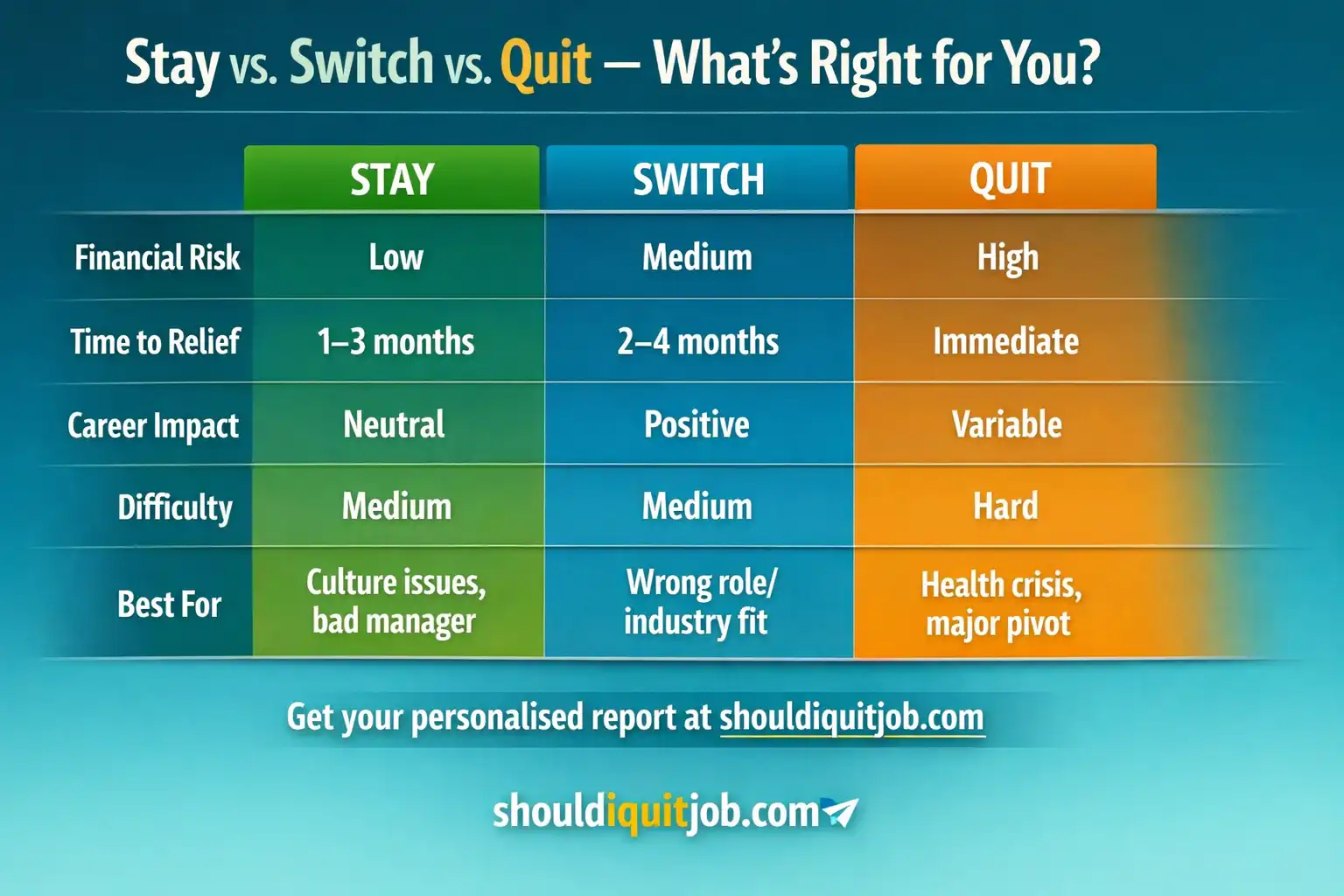
The Comparison at a Glance
| Factor | Stay | Switch | Quit |
|---|---|---|---|
| Financial risk | Low | Medium | High |
| Time to relief | 1 to 3 months | 2 to 4 months | Immediate |
| Career impact | Neutral | Usually positive | Variable |
| Income continuity | Yes | Yes | No |
| Difficulty | Medium | Medium | Hard |
| Best for | One fixable problem | Wrong company, right work | Wrong work, health at risk, major pivot |
How to Know Which Path Is Yours
Three questions. Answer them honestly.
1. Is your problem specific and changeable?
Name the single biggest thing making you unhappy at work. Now ask: could that thing realistically be different at this company within six months? If yes, Stay and try. If no, move on.
2. Do you like the work itself, or just the idea of liking it?
Strip away the company, the team, the manager, the commute. Just the actual tasks. The kind of problems you solve. The type of work you do every day. Do you enjoy that? Or have you been telling yourself you do?
If you enjoy the work and the company is the problem, Switch. If the work itself is wrong, Quit.
3. What’s your runway?
Calculate your monthly expenses. Now look at your savings. How many months can you sustain yourself without income? If the answer is less than three, you’re not ready to quit yet regardless of what your gut says. Build the number first.
One More Thing
Most people who are stuck in this decision are actually stuck because they know the answer and don’t want to deal with what comes next.
If you read through all three paths and one of them kept pulling at you, that’s probably the right one. The goal of this model isn’t to manufacture a decision. It’s to give you a clear enough framework to trust the one you’re already leaning toward.
Ready for your answer?
Get a data-backed verdict in 2 minutes
13 questions. Personalised Leap / Wait / Stay verdict. Financial runway analysis. Basic report free · Full analysis available · No login required.
Analyse My SituationThis content is for informational purposes only and does not constitute professional financial, career, or psychological advice. If you're experiencing symptoms of depression, anxiety, or burnout, please speak with a qualified health professional.