The Should I Quit My Job Quiz (With Instant Result)
Most people decide whether to quit based on emotion alone. This quiz measures the four things that actually predict whether leaving is the right move - and gives you a verdict in 2 minutes.

Most people decide whether to quit based on how they felt on a Tuesday.
Bad week, bad meeting, bad commute home. The anger spikes, they Google “should I quit my job,” and they’re looking for something to confirm a decision they’ve half-made already.
That’s not a quiz. That’s just a mood.
A real quiz measures the things that actually predict whether quitting is the right move. Finances. Burnout. Career alignment. Risk tolerance. Not just whether you had a rough quarter.
This one does that.
What Most Quizzes Get Wrong
Search “should I quit my job quiz” and you’ll find a lot of “10 signs it’s time to go” articles dressed up as quizzes. They ask whether you dread Mondays, whether your boss is difficult, whether you feel undervalued.
These things matter. But they’re only half the picture.
Someone with severe burnout and six months of savings has a completely different situation from someone with the same burnout level and two weeks of runway. Same feelings. Completely different right answer.
A quiz that ignores the financial reality gives you an emotional output, not an actual recommendation.
What This Quiz Actually Measures
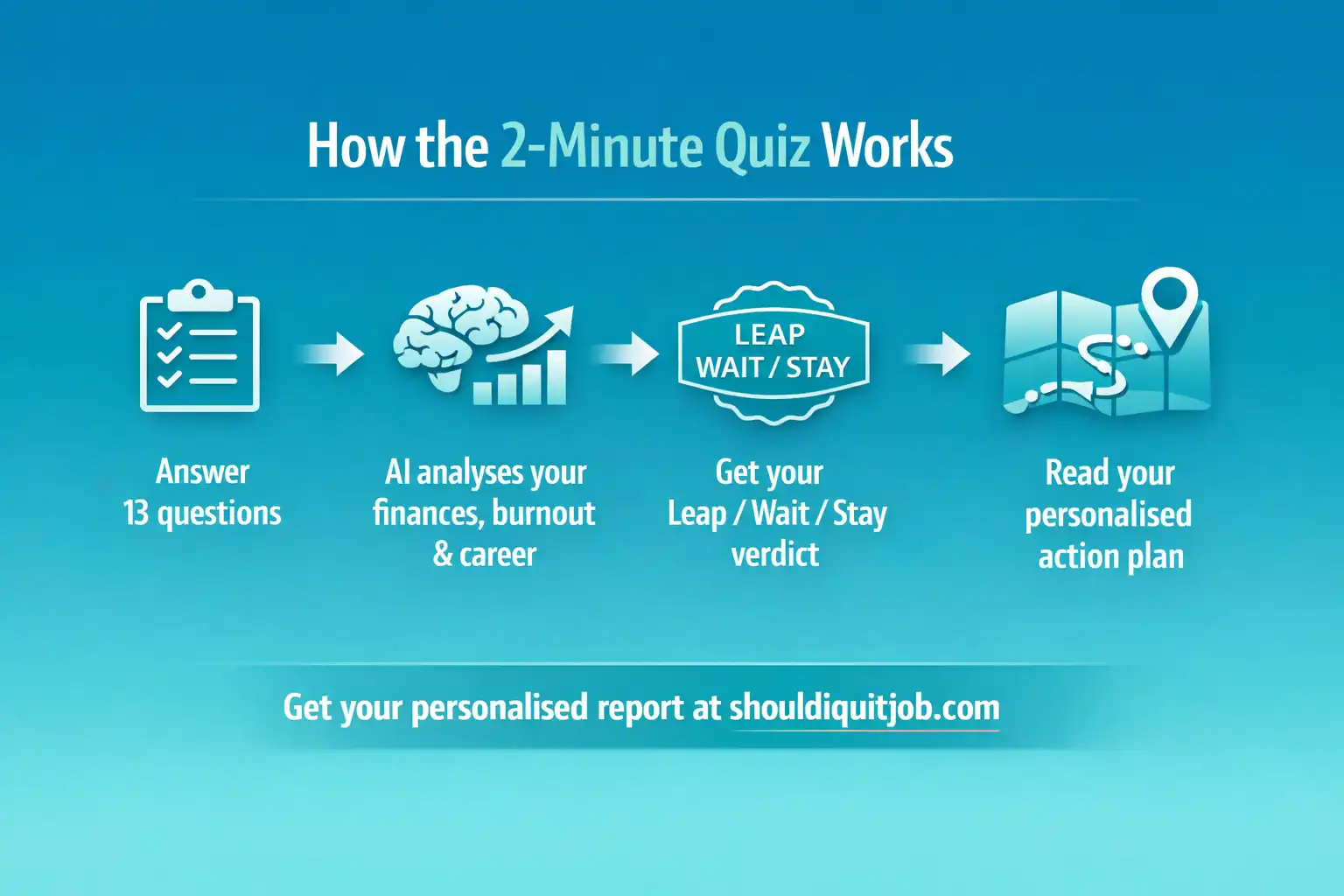
The analysis tool on this site asks 13 questions across four areas. Here’s what each one reveals and why it matters.
Your financial position
Can you actually afford to leave? This section looks at your income, your savings, your monthly expenses, and what your next step looks like financially.
It calculates your runway across five different scenarios, from best case to worst case. So you don’t just get a number. You get an honest picture of the risk.
Your burnout level
Not “do you feel tired.” The quiz uses the Maslach framework, the same model clinical researchers use to assess burnout, to measure three dimensions: emotional exhaustion, cynicism about your work, and your sense of accomplishment.
This matters because the right answer looks very different depending on whether you’re mildly burnt out or critically burnt out. High burnout changes the urgency of the decision.
Your career alignment
Is your current role moving you toward something? Is your next move a step forward or a sideways shuffle?
This section looks at where you are, where you want to go, and whether staying another year gets you closer or further from that.
Your risk tolerance and situation
Single or supporting a family? Side income or nothing lined up? Stable industry or one going through layoffs?
Context changes everything. Two people with identical finances and burnout scores can have very different right answers based on their personal situation.
What Your Result Means
The quiz gives you one of three verdicts: Leap, Wait, or Stay.
Leap
Your data points toward leaving. Financially you have enough runway, your burnout level is high enough that staying is costing you more than leaving would, and your next move is clear enough to act on.
Leap doesn’t mean quit today. It means the conditions are right. The risk of going is lower than the cost of staying.
Wait
Something important isn’t ready yet. Usually it’s the finances. Sometimes it’s that your next step isn’t defined. Occasionally it’s that your burnout is high but quitting into nothing could make things worse, not better.
Wait is not “no.” It’s “not yet.” The result comes with specific things to work on so that when you retake the quiz in 90 days, the picture is clearer.
Stay
The data doesn’t support leaving right now. Either the problem is fixable from the inside, your financial position makes leaving genuinely risky, or what you’d be moving toward isn’t clear enough to justify the jump.
Stay doesn’t mean stay forever. It means the current conditions point toward fixing something rather than leaving.
Every result also comes with a confidence score from 0 to 100. A score above 70 means the data clearly points one way. Below 40 means the signals are mixed and the situation needs more clarity before you act.
How to Use Your Result
The verdict is a starting point, not a final answer.
If you get Leap, don’t hand in your notice this afternoon. Use the action plan in your report to make sure the practical conditions are actually in place before you go. References sorted. Quit number calculated. Month 1 planned.
If you get Wait, don’t treat it as bad news. Use the 90-day window. Build the financial buffer. Get clearer on what comes next. The goal is to retake this and get a different result.
If you get Stay, dig into which specific factor is holding you back. Is it purely financial? Is the next step not clear? Knowing the reason tells you what to fix first.
One more thing. Take the quiz when you’re calm, not mid-crisis. If you take it right after a terrible week, your burnout score will be higher and your optimism about the future will be lower than normal. Your results will be skewed. A regular Tuesday afternoon gives you more accurate data than the day after a bad review.
Ready to Find Out?
The quiz takes two minutes. You answer 13 questions. The tool analyses your finances, burnout level, career alignment, and situation, then gives you a personalised verdict with a breakdown of what drove it and what to do next.
Basic report free · Full analysis available · No email required · No login.
Results are for informational purposes only and do not constitute professional financial or career advice.
Ready for your answer?
Get a data-backed verdict in 2 minutes
13 questions. Personalised Leap / Wait / Stay verdict. Financial runway analysis. Basic report free · Full analysis available · No login required.
Analyse My SituationThis content is for informational purposes only and does not constitute professional financial, career, or psychological advice. If you're experiencing symptoms of depression, anxiety, or burnout, please speak with a qualified health professional.