You Don't Hate Your Job - You Hate This One Thing
Most people who want to quit their job don't hate the job itself. They hate one specific part of it. Finding that part changes everything.
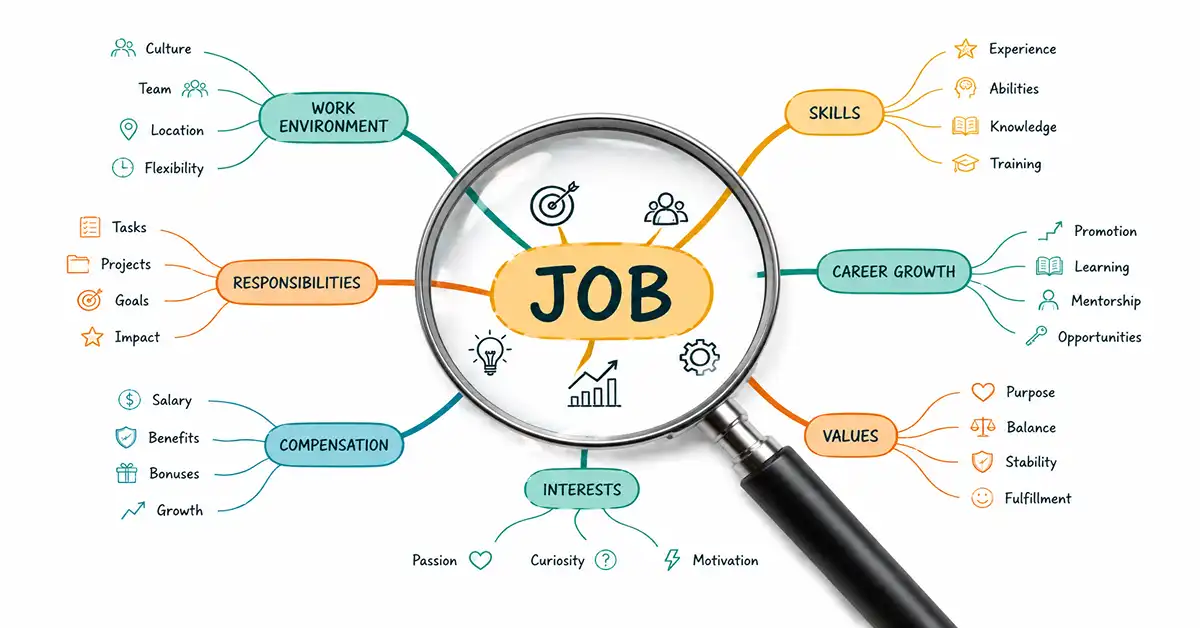
Before you hand in your notice, answer this one question.
What specifically is making you miserable?
Not “everything.” Not “just the whole thing.” Something specific. Because if you can name it, you might not need to quit at all. And if you can’t name it, you should probably figure it out before you make any big moves.
Most people who say they hate their job don’t actually hate the job. They hate one element of it. One person, one situation, one thing that poisons the whole experience.
The problem is that when you’re in it, everything feels bad. The work feels bad. The people feel bad. Getting up on Monday feels bad. It all merges into one big cloud of misery and it’s nearly impossible to see clearly.
Here’s how to cut through it.
A Job Is Not One Thing
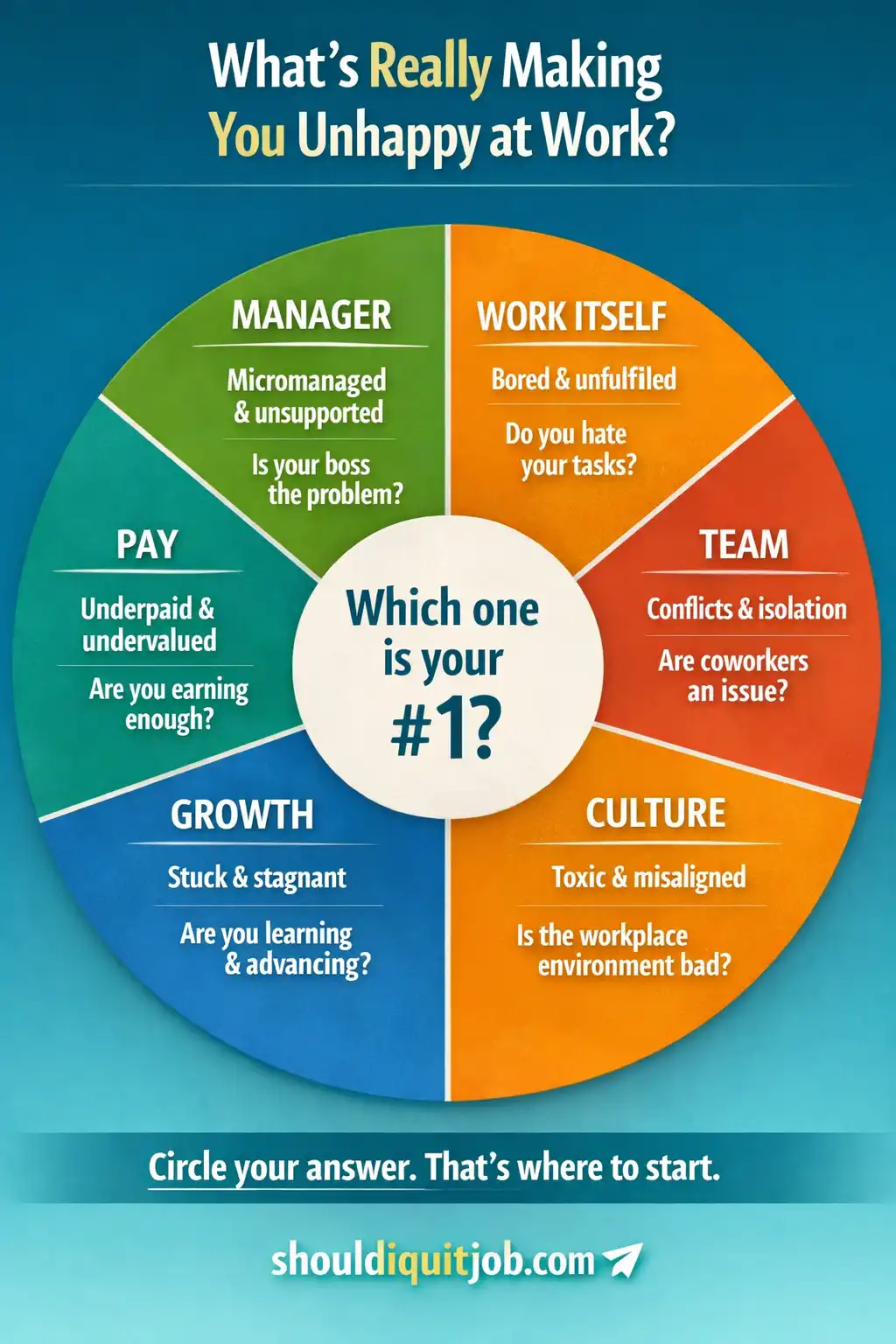
Your job is made up of six distinct elements. Each one can be good or bad, independently of the others.
The work itself. The actual tasks. What you do every day from when you open your laptop to when you close it. Do you find the problems interesting? Do you care about what you’re building or fixing or creating?
Your manager. The single biggest predictor of how you feel at work. A bad manager makes a great job unbearable. A great manager makes a mediocre job worth staying for. Research backs this up consistently - your direct manager accounts for more of your daily experience than almost anything else.
Your team and colleagues. The people you spend most of your working hours with. Do you enjoy them? Do you trust them? Do you feel like you’re working with people or just alongside them?
The company culture and values. What the company actually stands for versus what it claims to. How it treats people. Whether it does things you’re comfortable being associated with. This one is easy to dismiss until it’s suddenly all you can think about.
Growth and learning. Is this job making you better? Are you developing skills that will matter in three years? Or are you doing the same things you were doing two years ago, just more efficiently?
Compensation and recognition. What you’re paid. How your contributions are acknowledged. Whether you feel valued or invisible.
These six things make up your experience of work. And here’s the important part: any one of them, if bad enough, can make you feel like you hate everything.
Diagnose Which One Is Your Problem
Go through each element and score it honestly. Not compared to an ideal job - compared to what’s realistic. One to ten.
The lowest number is almost always where your actual problem lives.
The work itself
If the work is the problem, you probably feel the dread regardless of who you’re working with. You’ve had it on good teams and bad teams. It follows you between projects. The thought of doing similar work at a different company doesn’t feel much better.
This is the hardest kind of problem because it’s pointing toward a bigger change - a different field, a different type of role. It’s also the most important one to identify early, because no amount of switching employers will fix it.
Your manager
If your manager is the problem, things tend to look different in retrospect. Think back to a previous manager. Was work better then, even at this same company? Did you feel less drained?
If yes, it’s probably not the job. It’s this person.
The useful question here: is this likely to change? Is your manager new and struggling? Are there signs they’re leaving or being moved? Or is this person embedded, protected, and going nowhere?
A temporary bad manager is a very different situation from a permanent one.
Your team
If the team is the problem, you probably feel fine doing solo work but completely depleted after interactions. Meetings are the worst part of your day. You’ve withdrawn socially in ways you didn’t before.
Team problems can sometimes be fixed through transfers. More often they can’t - because the team reflects something deeper about how the company hires and how it manages people.
Company culture and values
This one creeps up slowly. You notice small things. A decision gets made that feels wrong. You start hearing “that’s just how it works here” more than you’d like. You find yourself not telling people where you work because you don’t want to explain it.
When values are the problem, it rarely improves. Culture comes from the top. If the people setting the direction have values that conflict with yours, your daily experience of working there is always going to carry that friction.
Growth and learning
Boredom and stagnation feel like unhappiness, but they’re actually a different problem. If growth is your issue, you’re probably not miserable - you’re restless. You’re coasting. You’re not being challenged and you’ve started wondering what you’re actually becoming.
The good news is this is sometimes the most fixable problem from inside. A different project, a stretch assignment, a conversation with your manager about what’s next - these things can actually move the needle.
Compensation and recognition
Feeling undervalued has two sides. The money side, which is concrete. And the recognition side, which is less concrete but often hurts more.
If this is your issue, you’ve probably never actually asked directly for what you want. Most people haven’t. That conversation feels uncomfortable, so they avoid it and quietly resent the outcome instead.
It’s worth having once before deciding the situation is unfixable.
The Isolation Test
Here’s the cleanest way to find your real problem.
Imagine your exact job - same work, same industry, same tasks - but with one element changed.
Different manager. Or different team. Or different company, different culture. Or double the pay.
Now ask: would I stay?
If swapping your manager would make you want to stay, your manager is the problem - not the job.
If imagining the same role at a company with better values would make you relieved, the culture is the problem.
If none of the swaps help - if you’d still want out regardless of who managed you or how much they paid you - the work itself is probably the problem.
Run through each element. The one where the swap produces the most relief is usually the one doing the most damage.
What To Do Once You’ve Found It
If it’s your manager: start actively working on a solution. Request a transfer. Start a quiet job search elsewhere in your industry. Or accept that you’re staying and deliberately limit how much emotional weight you give this person’s opinion of you. These are all real options. Vague hope that they’ll improve on their own isn’t.
If it’s your team: find out whether a move to a different team is realistic. At larger companies it often is. If it’s not, ask yourself whether you can build enough outside connection to offset the damage.
If it’s the culture: be honest about whether this is a “this company specifically” problem or an “entire industry” problem - the 3-path model helps. If it’s one company, a switch to a competitor with a different reputation can genuinely change things. If the values misalignment runs through the industry itself, that’s a bigger conversation.
If it’s growth: have the conversation you’ve been avoiding. Tell your manager directly what you want to work on and why. If they can make it happen, great. If the response is dismissive or impossible, that’s useful information about whether the company will ever give you what you need.
If it’s compensation: ask. Once, clearly, with data. What you’re being paid in your market, what your contributions are worth, what you’re asking for. A no after a real ask is different from a no you assumed before you tried.
If it’s the work itself: this one needs more time to sit with. Because it points toward something more fundamental. Not a fix, but a rethink. What kind of work would actually engage you? What would you do if this role didn’t exist and you had to start fresh?
When the Answer Actually Is “Everything”
Sometimes you go through the list and everything is low.
Bad manager, uninspiring work, team you don’t click with, values you’ve stopped believing in, no growth, not well paid.
When that’s the case, the diagnosis is still useful - it just points toward exit rather than a targeted fix.
But even then, there’s a second question worth asking: is this place the problem or is it you right now?
Because burnout changes how everything looks. When you’re depleted enough, the good stuff stops registering and the bad stuff fills the whole frame. A job that was fine a year ago can feel like the worst place on earth after eight months of overwork and accumulated stress.
If things have got dramatically worse in the last few months without a clear external cause, get some rest before you make any moves. Your read on the situation might not be accurate right now.
If the low scores have been consistent for a long time - not just during a hard stretch - then you have your answer.
The point of this exercise isn’t to talk you out of quitting. Sometimes quitting is right.
The point is to make sure you know what you’re actually solving for. Because if you leave without figuring that out, you’ll take the same unresolved problem with you to the next place.
Name the thing. Then decide what to do about it.
Ready for your answer?
Get a data-backed verdict in 2 minutes
13 questions. Personalised Leap / Wait / Stay verdict. Financial runway analysis. Basic report free · Full analysis available · No login required.
Analyse My SituationThis content is for informational purposes only and does not constitute professional financial, career, or psychological advice. If you're experiencing symptoms of depression, anxiety, or burnout, please speak with a qualified health professional.